Fuel & Running Costs
Carrying Spare Petrol on a Rental Motorbike: Risks and Alternatives
On this page
Should you carry spare petrol in a separate container on a rental motorbike in Vietnam? For an ordinary rented scooter or semi-automatic bike, a safer starting point is to plan reliable petrol stops and adjust the journey rather than improvise a fuel container. Petrol is a highly flammable liquid, and an extra container introduces the possibility of leakage, fumes, spillage, fire and unsafe luggage placement. Do not put petrol in an everyday drink bottle, assume the under-seat compartment is suitable, or copy a social-media technique for tying a container to the bike. Ask the rental provider about the actual bike, fuel type, allowed route and any restrictions before departure.
Why a little extra petrol is not ordinary luggage
A bottle of water, a rain jacket and a fuel container do not pose the same risk. Petrol produces flammable vapour, and a leak can spread fuel over clothing, luggage or parts of the vehicle. Heat, physical damage and potential ignition sources make the consequences of a mistake much more serious than losing an everyday item. The fact that a container seems small does not guarantee that carrying it on a motorcycle is safe or legally compliant.
Renting also means you are using someone else’s vehicle under an agreement. Even if a traveller has experience with a separate fuel can on a privately owned off-road bike, that does not establish permission to do the same on a standard rental motorcycle in Hanoi.
Vietnam’s police fire-prevention and rescue authorities have repeatedly warned that keeping petrol in separate containers can create significant fire and explosion hazards. Their March 2026 public guidance addresses fuel stockpiling in homes rather than the exact situation of a small container on a rented bike, so it must not be misquoted as a motorcycle-specific rule. The underlying fire and vapour hazards nevertheless deserve serious attention.
See the Fire Prevention and Rescue Department’s March 2026 warning on petrol storage. It describes flammable material, high temperatures, leak prevention and ignition hazards. It does not approve any particular container or motorcycle-carrying arrangement.
Questions that are more useful than choosing a fuel container
| Question | Why it matters | Action before departure |
|---|---|---|
| What fuel does the bike actually require? | Wrong fuel can damage the engine | Ask the shop about the specific model and grade |
| How much fuel is in the tank at pickup? | The starting level affects your first stop | Record the agreed handover level |
| Where is the next reliable petrol station? | Remote stretches may offer no retail fuel | Mark several possible stations on the route |
| What is the permitted route? | The rental may restrict distance or area | Seek explicit approval for the actual itinerary |
| What if the next station is closed? | One planned stop may not be enough | Prepare a legal shorter route or turnback |
| Does the provider allow any external fuel container? | Unapproved cargo can violate terms and create hazards | Ask the shop; don’t make assumptions |
A customer should be able to answer these questions without experimenting with a container, fuel transfer or mechanical changes to the bike. If a proposed journey requires carrying fuel because there are no suitable stops, reconsider the vehicle or route rather than treating the extra container as a routine accessory.
What about using a plastic drink bottle or improvised can?
Do not use a consumer drink bottle, an unlabelled container, a damaged can or improvised luggage packaging for petrol. Such items were not supplied as approved fuel-storage equipment for the particular vehicle, and you cannot infer their safety from their appearance. Trying to use an ordinary bottle also increases the danger that someone will mistake its contents for a beverage.
The message is not to compare which improvised bottle is stronger. It is to avoid the improvised arrangement and to seek a safer route and refuelling plan. A rental customer should not modify the machine or install extra fuel hardware without the owner’s explicit agreement and appropriate professional assessment.
Is buying petrol in a can automatically illegal?
Do not make a blanket claim either way. In a November 2022 explanation, Vietnam’s Ministry of Industry and Trade distinguished the rules for selling petrol through containers from the question of a consumer buying petrol in one. That explanation did not establish that carrying a container on any motorcycle is always permissible, safe or exempt from other requirements. Petrol-related and hazardous-goods rules can change, and their application depends on the circumstances.
Read the Ministry’s distinction between retail petrol sales and consumer purchases as historical context, not as a current legal permission for a specific journey. Consult the relevant authorities about applicable transport rules if you have a genuinely specialised fuel-transport need.
Why a rental shop’s permission matters separately
Even when someone has identified a lawful way to transport a particular product, the rental agreement may independently prohibit carrying hazardous substances or attaching unusual cargo. A bike’s weight limits, luggage arrangement and intended use are model-specific. Do not assume that because another tourist once carried a container, Nguyen Ha permits it for every rented vehicle.
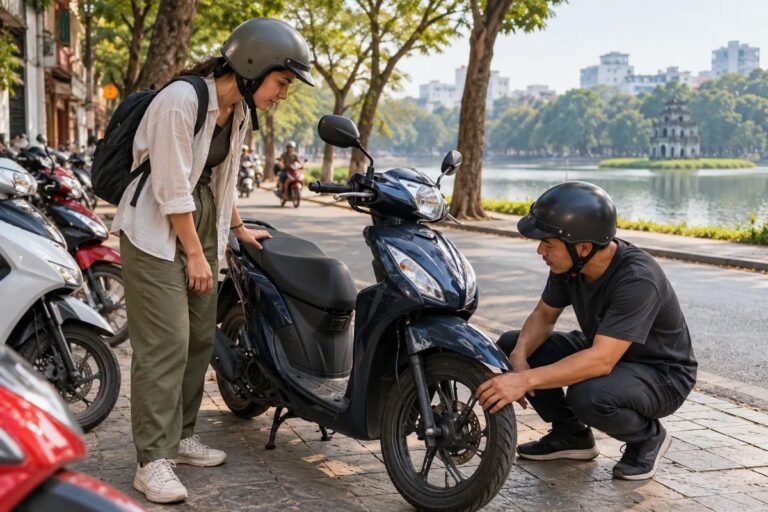
Before travelling beyond Hanoi, ask about the planned destination, the likely distance, the fuel requirements and the arrangements for reporting problems. Nguyen Ha’s vehicle availability and exact terms must be confirmed for the bike you would receive; this article does not declare that the shop sells spare fuel or provides fuel containers.
A safer method: map fuel stops before the journey
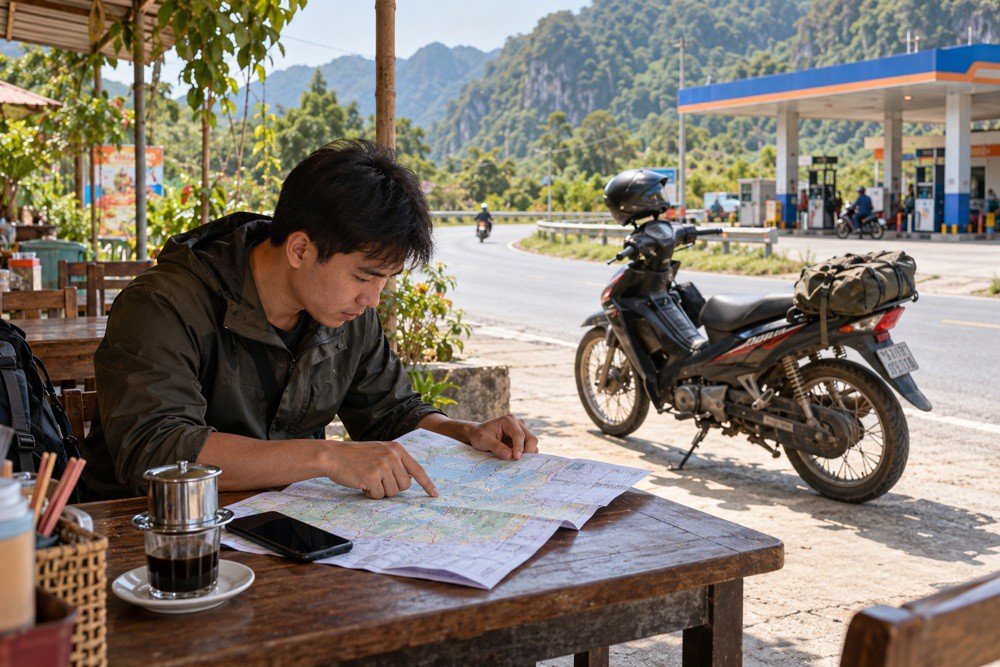
Begin with the map for your intended route and locate legitimate petrol stations near the start, along the corridor and before any sparsely serviced section. Check that a station is actually reachable from your permitted direction of travel. A petrol station visible across a divided road may require a significant legal detour, so do not count it as an accessible stop without examining the junctions.
Use the Vietnamese guide to marking fuel, rest and toilet stops as a checklist. Search results, map reviews and listed opening hours can be outdated; when a stop is critical, obtain current confirmation rather than trusting a pin alone.
What if a rural road has a long gap without stations?
Compare the gap between reliable fuel stops with the actual bike’s practical range, taking into account traffic, road grade, load and conditions. The tank capacity printed for a model does not tell you exactly how many kilometres this particular rented bike will travel on a given day. Avoid advertising a universal range without model-specific evidence.
If there is insufficient margin to reach the next confirmed station and return to a safer point, shorten the itinerary or select a different authorised route. Do not create a false sense of security with an untested container. The Vietnamese guide to sparsely spaced petrol stations and deciding when to turn back discusses this planning problem in more detail.
Refuel before entering a remote section
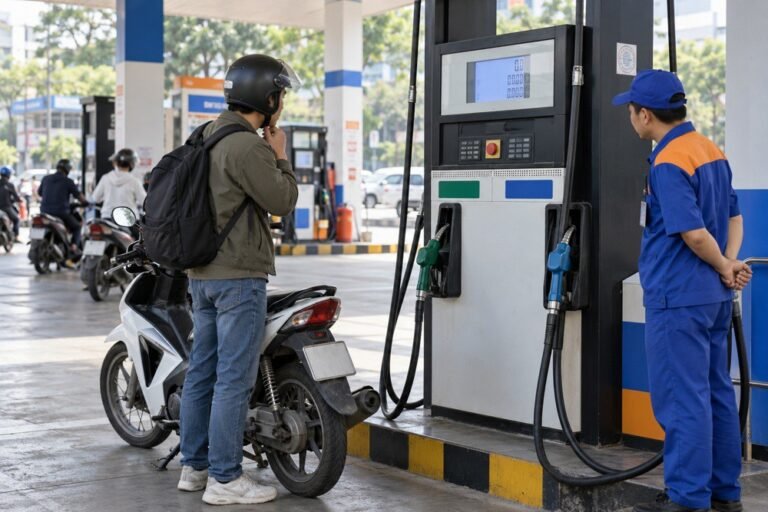
When you find a legitimate operating petrol station before a long gap, stop there rather than relying on an assumed station further ahead. Use the fuel type specified for the actual bike and follow station safety instructions. Keep the bike stationary during refuelling and obey the staff’s directions; do not smoke, use open flames or improvise fuel handling.
Ask the rental shop at pickup how to recognise the low-fuel warning or gauge on that model. A warning indicator is not an exact distance counter, and the remaining distance can vary substantially. Plan fuel stops with a reasonable margin rather than waiting for an empty tank or assuming a warning light means the next village will be reachable.
Do not confuse engine trouble with a low fuel level
A bike that is stalling, failing to start or showing a warning light may have a problem other than lack of petrol. Avoid repeatedly trying to start it or disassembling the fuel system. Stop in a safe, permitted place and contact the rental provider, describing the symptoms, location and gauge reading without making unsupported diagnoses.
If you suspect a fuel leak, notice strong petrol fumes or see smoke, prioritise getting people away from the hazard and obtaining appropriate emergency assistance. Do not try to carry, transfer or repair leaking fuel equipment yourself, and do not create an ignition source nearby.
A practical route-review table
| Stage | What to confirm | Fallback |
|---|---|---|
| Pickup in Hanoi | Bike, tank level, required fuel and rental terms | Ask the shop before accepting an unsuitable vehicle |
| First fuel stop | Legitimate station reachable on permitted roads | Use another confirmed station before the remote stretch |
| Rural corridor | Actual distance and working stations | Shorten the route when coverage is uncertain |
| Unexpected closure | Legal direction and safe detour | Turn back or postpone instead of using prohibited roads |
| Return to Hanoi | Remaining fuel and agreed return condition | Refuel at an appropriate station before handover |
Do not use a hypothetical map or fuel consumption figure as proof that a real station is currently open. Check the journey as a complete sequence of lawful roads, not just the distance between two dots.
What if you are already low on petrol far from a station?
Acknowledge the uncertainty early. If you can safely reach a suitable station on the legal route without risking running out, assess that option conservatively. If you are not sure, stop in a safe location before the situation becomes more hazardous, record your position and contact the rental provider for guidance on appropriate assistance.
Do not push the bike into high-speed traffic lanes, cross a prohibited median to reach a station or accept fuel from an unknown unlabelled bottle. If you are in a dangerous location, prioritise personal safety and competent roadside or emergency assistance over preserving the rental schedule.
How to discuss a long provincial trip with the provider
- Describe the intended destination and roads rather than just saying “a long trip”.
- Confirm whether the particular available rental may be taken there.
- Ask about fuel type, tank information and the return fuel condition.
- Mark legitimate petrol stations and a backup along each permitted section.
- Ask how to report breakdowns and what geographic support is actually available.
- Do not install a fuel tank or attach a hazardous container without authorisation and specialist compliance advice.
- If the route depends on carrying extra petrol, reconsider it and discuss safer alternatives.
Being prepared does not mean travelling with the maximum amount of gear. For most ordinary motorbike rental plans, it means choosing a route, timing and refuelling strategy that avoid the need for risky improvised equipment.
Message to send before departure
Hello Nguyen Ha, I am considering a rental motorbike trip from Hanoi to [destination] via [route]. I am concerned about the distance between petrol stations and do not want to carry fuel in an improvised container. Please confirm whether the actual bike is permitted on this route, which fuel it uses, any mileage or geographic restrictions, and what I should do if petrol stations are unavailable or the vehicle breaks down. I will shorten or change the journey if reliable refuelling cannot be planned.
Frequently asked questions
Is a small plastic bottle of petrol safe in a scooter compartment?
Do not assume so. An improvised container introduces fire, vapour, leak and storage risks. Plan petrol stops instead, and ask the rental provider about its restrictions.
Did a government statement saying buying petrol in cans is not categorically banned approve carrying one on a motorbike?
No. That statement addressed a different legal question and does not certify the safety or legality of a specific transportation arrangement.
What if the next petrol station on my map is closed?
Use a verified alternative, return on a legal route if safely possible or postpone. If uncertain or already low on fuel, stop safely and seek proper assistance rather than improvising.
Nguyen Ha Motorbike Rental: Ngõ 5 Nguyễn Văn Cừ, Bồ Đề, Long Biên, Hanoi, Vietnam, open 09:00–21:00 daily. Call +84 334 699 969 about vehicle availability, permitted routes and fuel requirements.