Fuel & Running Costs
How Throttle and Braking Habits Affect Fuel Use on Hanoi Streets
On this page
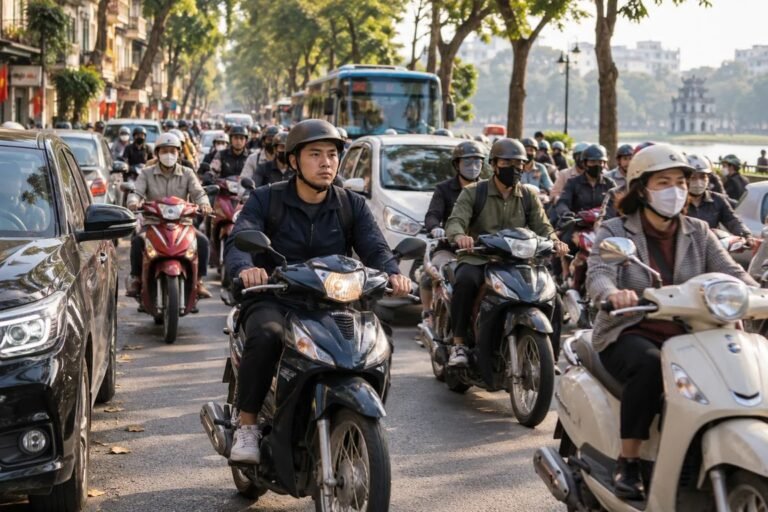
Two people can travel the same distance through Hanoi on similar motorcycles and still use different amounts of petrol. The route, traffic, passenger load, weather, maintenance and riding style all matter. In stop-start traffic, repeated hard acceleration followed by abrupt braking can waste energy compared with anticipating a red light and riding at a smooth, appropriate speed.
The aim is not to travel unusually slowly, coast without control or chase a particular fuel-economy number. The aim is to make predictable decisions that also help you share the road safely. This guide explains which riding habits may affect fuel consumption and how to compare actual receipts without inventing a savings percentage for your rented bike.
Why acceleration and braking matter together
A petrol engine burns fuel to create movement. When the motorcycle speeds up, the engine supplies energy. When the rider brakes, some of the vehicle’s movement energy becomes heat in the braking system. Repeating that cycle unnecessarily in every short gap between traffic lights may use more fuel than a smoother approach.
| Riding pattern | Potential effect | Safer alternative |
|---|---|---|
| Twist the throttle hard after every green light | Repeated strong acceleration increases engine demand | Accelerate progressively when conditions allow |
| Rush toward a visible red light then brake | Uses energy to accelerate before discarding it at the brakes | Look ahead and begin reducing speed earlier |
| Maintain a suitable, steady speed in open traffic | Avoids unnecessary speed changes | Preserve a safe gap without blocking others |
| Ride at high speed to save time | Air resistance and engine demand can rise | Respect speed limits and choose suitable conditions |
| Carry extra weight unnecessarily | More load may require more power | Pack appropriately, without compromising safety |
Reading traffic earlier is more useful than chasing a number
Look beyond the vehicle immediately in front of you. If a queue is forming at a signal, a calm rider may be able to reduce throttle and slow progressively while preserving a safe following distance. A rider who accelerates into the queue then brakes hard may gain little travel time.
Never roll toward a stop without enough control or space to respond. Traffic can change suddenly, pedestrians may cross and another vehicle may enter the gap. Safety overrides fuel saving in every situation.
Does constant speed always mean the lowest fuel use?
No. A safe, appropriate speed is important, but actual efficiency depends on the engine, gearing, road slope and load. Trying to maintain one exact speed through a congested junction is not realistic or safe. Even two motorcycles with identical marketing names may have different engine condition and fuel-system characteristics.
An automatic scooter and a semi-automatic motorbike also respond differently to the throttle. Use the normal operating guidance for the model you receive, rather than applying the same gear-selection advice to every bike.
Why abrupt braking is not a fuel-saving strategy
Braking is essential whenever road safety requires it. Do not avoid an appropriate stop to preserve fuel. The relevant difference is between necessary braking and the repeated choice to accelerate when a stop is already foreseeable. Building a bigger following gap can reduce the number of unnecessary speed corrections.
In heavy traffic, the most efficient route is not necessarily the shortest path by distance. Several traffic lights, queues or steep slopes can change the outcome. Use the actual ride and receipts for comparison rather than assuming one path will always consume less petrol.
Tyres, luggage and the road can outweigh a small change in throttle
Tyre pressure outside the manufacturer’s recommendation may affect handling and resistance. Heavy or poorly positioned luggage can alter balance and demand more effort. A passenger changes both the bike’s load and its braking behaviour. Ask the rental shop for the correct tyre and carrying information before departure.
Do not overinflate tyres to chase a small fuel saving. Pressure should follow the specific motorcycle and its approved load. If a tyre is visibly flat or damaged, stop using the bike and ask for assistance.
What about waiting at a red light?
Some scooters have a manufacturer-designed idling-stop system that can shut the engine off during a stop and restart it automatically under defined conditions. Other bikes have no such system. A rider should learn the exact controls and limitations before using it. Manually switching off the ignition at every brief stop is not a universal recommendation.
For a closer look at that decision, see our scooter idling-stop system guide. This fuel-use article does not establish what feature is fitted to any particular rental motorcycle.
A simple way to compare fuel costs fairly
Record the odometer and litres when refuelling, then compare similar stretches of ordinary use. The standard calculation is litres divided by kilometres and multiplied by 100. For example, a hypothetical 2.5 litres used over 100 km equals 2.5 L/100 km. That example is arithmetic, not a quoted result from Nguyen Ha’s fleet.
Keep notes on traffic, luggage, route and weather. A weekend journey on open roads is not a fair comparison with weekday travel through crowded junctions. Short comparisons are especially sensitive to how much petrol was in the tank at each refill.
Do not overfill the tank just to measure it
Use the model-specific fuel-limit instructions rather than topping up to the very rim for the sake of repeatability. On some motorcycles the manufacturer specifies a visible fill level or marker; other designs require a different approach. Petrol can expand with temperature, and excessive filling may create a spill hazard.
Fuel-saving habits that do not sacrifice safety
- Leave enough time to travel without rushing between signals.
- Look ahead and maintain an appropriate following distance.
- Accelerate smoothly when it is safe and legal.
- Slow early for a visible queue or junction while remaining ready to brake properly.
- Carry only what the bike can securely accommodate.
- Check model-specific tyre recommendations and ask the shop to address problems.
- Use the correct fuel grade specified for the motorcycle.
Each habit has a safety purpose as well as a possible efficiency benefit. Avoid riding too close to another vehicle, switching off an engine while moving downhill or selecting neutral to coast. Those shortcuts can reduce the rider’s control and create unnecessary risk.
What about going slowly in a high gear?
A semi-automatic motorcycle needs an appropriate gear for its speed and load. Selecting an excessively high gear at low speed can make the engine labour and the bike respond poorly. Do not imitate a generic shift-speed chart from a different model or use the gearbox to test how little fuel the engine can consume.
Automatic scooters control their transmission differently and do not need manual gear selection. At pickup, ask the shop to demonstrate any unfamiliar controls before riding in congestion.
How to recognise a problem that is not simply riding style
A sudden change in fuel use together with a strong petrol smell, a visible leak, new loss of power, brake drag or a warning indicator deserves inspection. Do not insist on changing driving habits to compensate for a potentially unsafe motorcycle. Park safely and contact the owner.
How much can you save in a month?
There is no defensible universal figure for every Hanoi rider. Actual petrol savings depend on the motorcycle, kilometres travelled, fuel price, existing habits and congestion. If you want an estimate for your own rental, record a few comparable weeks and calculate the difference using your actual fuel receipts. Do not multiply a car-based fuel-efficiency percentage by an arbitrary scooter price.
Questions for the rental handover
- Does the available bike have a built-in idling-stop feature?
- Which fuel grade and tyre pressures does the manufacturer recommend?
- Does the shop have any advice about operating the exact automatic or semi-automatic model?
- What should the renter report if fuel use suddenly increases or the bike starts behaving abnormally?
For the current rental categories and terms, see Nguyen Ha’s Hanoi rental overview. Questions about an available vehicle can be directed to 0334 699 969. No particular model’s fuel-economy number or availability is asserted here.