Fuel & Running Costs
Overfilling a Motorcycle Fuel Tank Before Parking in the Sun
On this page
Filling a motorcycle’s petrol tank to the very rim may feel like a way to travel farther between stops. But petrol can expand as temperature rises, and the manufacturer normally specifies a maximum safe fill level. If you top up beyond that level and then park the motorcycle in the sun, the extra liquid may spill or enter places it was not intended to go. The rule for a renter is simple: follow the fuel-fill instructions for the exact model, and do not keep adding petrol merely to round the pump’s display up to a convenient number.
The details vary between motorcycles, including the position of the filler opening, fuel tank shape, cap and ventilation system. Some manuals use a visible plate or lower neck edge as the limit; others address an automatic pump shutoff. No single photograph or fill-level measurement in this article is suitable for every model in Nguyen Ha’s Hanoi rental fleet.
What happens when petrol warms up?
Liquid petrol changes volume with temperature. A tank filled beyond its permitted limit may have too little room to accommodate expansion. The result can be spillage around the cap or other fuel-system concerns, depending on the tank and ventilation design. Petrol vapours are flammable, so even a seemingly minor spill needs careful handling.
Do not assume that the tank will “sort itself out” merely because the smell becomes weaker later. An unexplained strong smell or continuing wet patch should be reported to the owner before starting or moving the motorcycle.
What Honda manuals actually say
Honda Vietnam publishes model-specific owner manuals. One Honda owner manual showing the filler-neck limit instructs the rider not to fill beyond the lower edge of the fuel-filler neck. Another Honda manual describing automatic pump shutoff says not to add petrol after the nozzle stops because the remaining space accommodates changes in ambient temperature.
These examples demonstrate that there are explicit limits in manufacturer documents, not that every motorcycle uses the same cap, nozzle or line. Ask the shop to show the fuel section for the specific model you will receive, especially if its filler opening is under the seat.
Fuel limits are different from advertised tank capacity
A specification might list a tank capacity in litres, but that does not mean you should force the same measured amount into the tank on every visit. Some fuel is already present, the bike may not be level and the permitted filling limit may be indicated by a physical marker. The pump total alone does not tell you whether the tank has been filled correctly.
| Common assumption | Better practice |
|---|---|
| “I must fill right to the mouth to get a full tank.” | Stop at the manufacturer’s stated limit |
| “The pump stopped, so adding a little more cannot hurt.” | Follow the model’s guidance about nozzle shutoff and topping up |
| “Every Honda has the same visible fill line.” | Check the correct manual and tank design |
| “A fuel smell after parking in the sun is always normal.” | Report an unusual or strong smell and any visible wetness |
| “A tank with more petrol always gives a safer trip.” | Plan fuel stops without overfilling |
Safe behaviour at the filling station
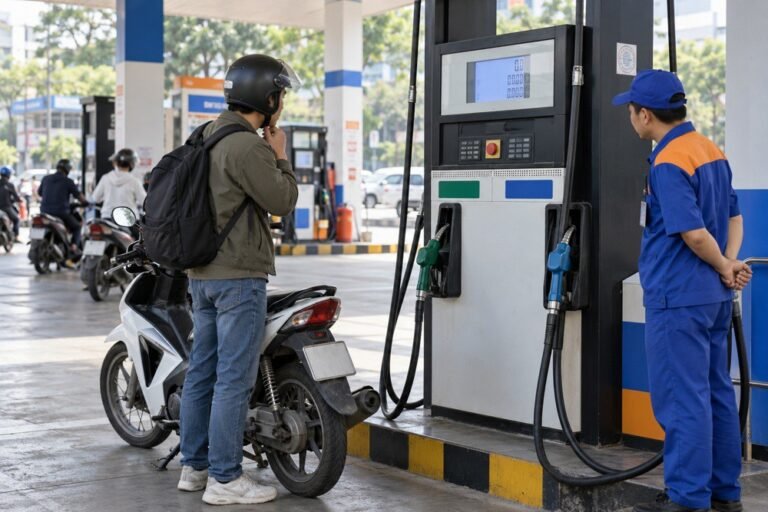
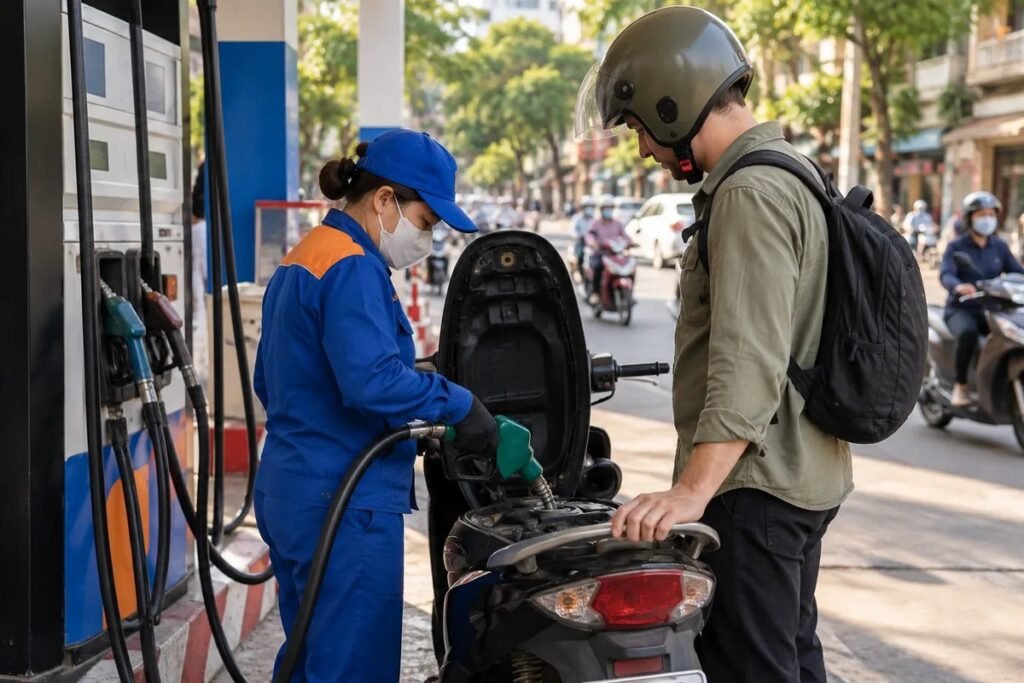
Switch off the engine and obey the station’s safety notices. Avoid smoking, open flames and other ignition sources. Open the fuel cap following the motorcycle’s instructions, and keep your face away from the opening. Ask the station attendant to stop at the correct level rather than pumping more to reach a round cost figure.
After refuelling, ensure the cap is secured as the owner manual describes. If you are unsure whether it has locked properly, ask for help before riding. Never leave the fuel cap loose so vapour can “escape” during a hot day.
What if the nozzle stops automatically?
For a motorcycle whose manual uses an automatic shutoff procedure, a click may be the normal signal to stop filling. Do not keep squeezing the nozzle to “top off” unless the manual specifically provides another safe procedure. Not every motorcycle tank or station nozzle behaves identically, so the correct fill level remains model-specific.
Where the owner manual uses a visible maximum marker instead, use that guidance rather than treating the nozzle click as an infallible measurement. The Honda examples above show why an individual manual matters.
What changes when the bike is parked outdoors?
Sunlight can warm the tank and nearby body panels, increasing the importance of the manufacturer’s expansion space. Choose lawful parking in a shaded, stable place when convenient, but do not park illegally or obstruct pedestrian access simply to avoid sunshine.
Shading the motorcycle does not make overfilling acceptable. The right action is to respect the normal fuel limit at the time of filling, regardless of how hot the afternoon may become.
What if a scooter’s filler cap is beneath the seat?
Some scooters have an underseat access arrangement. Keep documents, rainwear and other belongings from interfering with the fill opening, and watch for petrol splashes. But the exact layout varies, and some designs place the fuel cap elsewhere. The shop should demonstrate the real model’s cap and safe filling process.
See our underseat storage guide for general packing questions. A storage compartment is not a suitable place to keep loose petrol containers or petrol-soaked cloths.
Signs that require reporting rather than more riding
- Visible petrol dripping or a new wet patch beneath the motorcycle.
- A strong petrol smell near a tank, cap or underseat opening.
- Petrol spilled near an exhaust or another hot component.
- A cap that will not close or lock properly.
- Smoke, unusual heat or another immediate fire concern.
If fuel is leaking or there is an apparent fire hazard, keep the engine switched off where safe, move people away from the source and seek appropriate assistance. Do not restart the motorcycle to check whether a leak continues. Do not carry a petrol-soaked rag in a seat compartment.
Should you wipe up a small spill?
Follow the station attendant’s instructions and local safety procedures. Do not use random cleaners, flush petrol into a drain or attempt to deal with a larger or continuing spill yourself. If there is danger, leave the area and report it. Petrol is highly flammable, so protecting people is more important than removing a mark from the paint immediately.
Can you open the cap to release pressure after parking?
Do not open a hot tank merely as an experiment. If you smell fuel, hear an unfamiliar sound or see a leak, keep the bike parked and ask the provider for appropriate guidance. Different tanks vent differently, and a rider should not improvise changes to the fuel cap or hoses.
Why this matters for measuring fuel consumption
Some riders repeatedly fill beyond the intended limit to make every refill seem identical. That is not a valid reason to ignore the manufacturer’s safety instructions. For consumption records, use a consistent safe fill method and compare several journeys instead of forcing the fuel level to an unsafe point.
A question about the rental contract
When accepting a bike, ask what fuel grade to use, how the fuel gauge is checked at return, and how to report an accidental spill. Do not assume that every rental company uses the same full-tank policy or charges the same amount for fuel differences. Have any material terms confirmed by the specific business.
A short checklist before you leave the station
- Confirm the correct petrol grade for the actual motorcycle.
- Check that the fuel level has not exceeded the model’s guidance.
- Make sure the cap is secured correctly.
- Look for obvious spillage without touching hot components.
- If you notice a problem, report it before starting the engine.
What if the tank was already overfilled?
Do not siphon petrol by mouth, tilt the bike to spill it out or attempt to disconnect a fuel line. If an attendant or the owner identifies an unsafe fill, ask qualified staff to arrange the appropriate solution. The correct response depends on the tank and the amount of excess fuel; a general article cannot prescribe a repair for every motorcycle.
For related rental details, consult Nguyen Ha’s current rental information. If your bike shows an unusual fuel smell, overfill or leak after a stop, contact 0334 699 969 and describe the actual conditions.