Fuel & Running Costs
Why Running Fuel-Injected Motorbikes Completely Dry Can Cause Problems
On this page
Waiting until a fuel-injected motorbike completely runs out of petrol can leave you unexpectedly stopped in traffic or far from a filling station. It may also create fuel-system or restarting complications depending on the motorcycle’s design. But the broad claim that a single empty tank automatically destroys every fuel pump or engine is not supported. The safest practical habit is to refuel before the motorcycle is struggling, and to follow the actual owner’s manual instead of guessing how many kilometres remain after the last fuel-gauge bar.
For a rental in Hanoi, this is as much about avoiding a dangerous roadside situation as it is about protecting components. This guide explains the difference between fuel injection and a carburettor, why the location of a fuel pump matters, and which observations to send the rental provider. It does not diagnose a faulty pump or claim that every fuel-injected model has an identical system.
What happens in a fuel-injected motorcycle?
A fuel-injection system uses controlled fuel delivery through an injector. Depending on the model, an electric pump supplies fuel at the pressure needed for that system. Many designs place the pump in or near the fuel tank, but the exact arrangement should be confirmed with the motorcycle’s technical documentation.
A carburettor-equipped motorcycle may use a different fuel-delivery arrangement, sometimes involving a gravity-fed system. This distinction does not mean an older carburettor bike can safely be run out of petrol on a busy road. An unexpected stall or loss of propulsion is a problem for any rider.
Does an empty tank definitely destroy the fuel pump?
No universal conclusion can be made from the fuel gauge alone. Some pumps are located within the fuel tank, and the surrounding fuel can play a role in heat management in particular designs. The severity of any effect depends on the pump, fuel level, operating conditions and how long the system is operated without adequate fuel. A single incident does not prove failure.
Honda Vietnam’s motorbike operating FAQ makes an important distinction: repeatedly running out of petrol does not directly equate to shorter engine life, but may create problems related to tank conditions, fuel delivery and sudden engine stoppage. That manufacturer explanation is more nuanced than internet claims that every empty tank immediately burns out a pump.
What risks are worth avoiding?
| Situation | What may happen | What not to assume |
|---|---|---|
| Engine runs out while moving | Loss of engine power at an inconvenient or unsafe point | The bike will always coast to a safe place |
| Repeated attempts to start an empty bike | Battery drain without resolving the lack of petrol | Repeated cranking will refill the fuel system |
| Low fuel with an in-tank pump | Conditions around pump operation may change | Every in-tank pump will be damaged immediately |
| Long periods with a partly empty metal tank | Condensation or corrosion may matter for some designs | All modern fuel tanks use identical materials |
| Rough running or stalling | Fuel shortage is one possibility among others | The cause is proven without inspection |
The table identifies possible concerns, not a checklist for proving damage. If a motorbike repeatedly stalls or loses power, ask for professional assessment rather than adding petrol and assuming all possible faults have been ruled out.
The last gauge bar is not a distance guarantee
Fuel-gauge bars and low-fuel warning lamps do not have a universal meaning. Remaining usable fuel, tank shape, slope and sensor design vary by model. A rider cannot reliably translate the final bar into an exact number of kilometres without the specific manual and conditions.
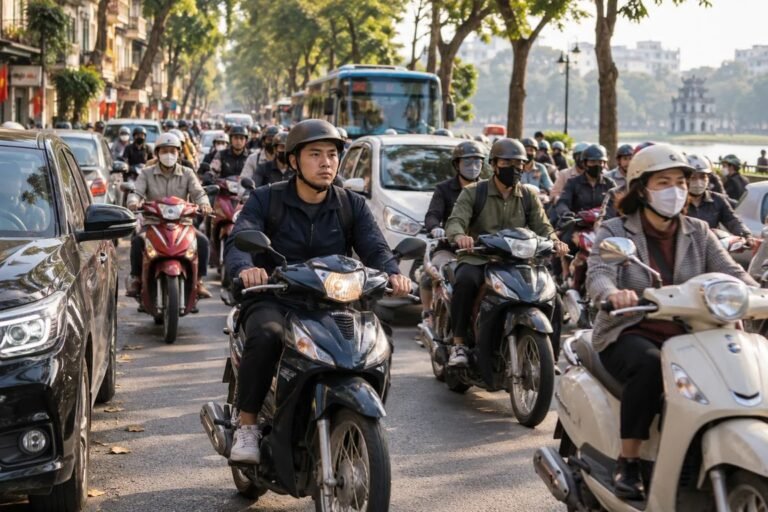
A particular road in the outskirts of Hanoi may also have fewer convenient petrol stations than central districts. If you plan a longer route, check the likely availability of fuel stops before leaving and allow for changes in opening hours.
What to do when the low-fuel indicator appears
- Take the warning seriously and plan to refuel promptly.
- Stop safely before using a phone to locate a petrol station.
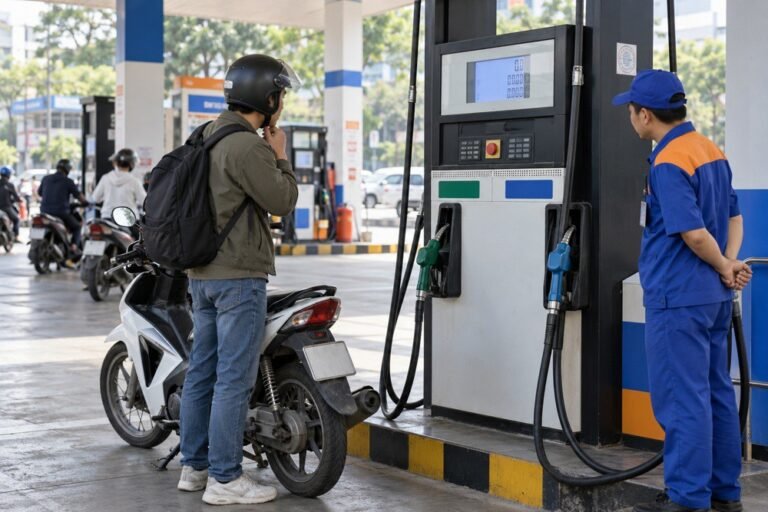
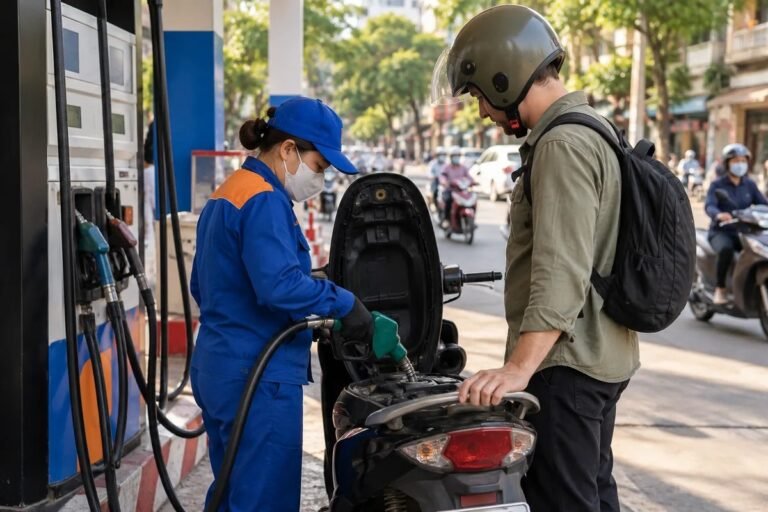
- Use the fuel grade recommended for the actual bike.
- Avoid unnecessary rapid acceleration and prolonged detours.
- If the bike begins to hesitate, lose power or stall, stop and contact the rental provider.
Do not ride in an unsafe area solely to find a preferred petrol station. If the motorcycle’s behaviour is uncertain, the owner needs to advise whether it should be moved and how. The available fuel range cannot be guaranteed by a general article.
How to avoid misleading “fuel-saving” experiments
Riding an injection-equipped motorcycle to the last drop is not a valid way to measure fuel economy. The result may be affected by starting position, road conditions and the fuel that cannot be drawn from a tank under particular circumstances. It also creates avoidable inconvenience and possible safety risks.
Use ordinary refuelling records instead. Our fuel-use log for monthly rentals</a explains how to compare kilometres and litres across normal journeys without intentionally exhausting the tank.
If the engine stops and you suspect the tank is empty
Concentrate on stopping or securing the motorcycle as safely as conditions allow. Do not attempt to restart repeatedly in the middle of a lane or near moving traffic. Once in a safe place, switch off the engine and contact the rental provider, noting the location, the indicated fuel level and what happened immediately before the engine stopped.
Do not assume every stall is due to a lack of petrol. An ignition, electrical or mechanical problem may produce similar symptoms. Explain what you observed instead of stating that a particular fuel-system component has failed.
Should you carry petrol in a bottle?
Do not carry fuel in an ordinary drink bottle or improvised container. Petrol vapour is flammable, and accidental leakage can create danger for the rider and others. Ask the rental provider what to do if no suitable fuel station is reachable, and use appropriate professional assistance rather than improvising roadside handling.
If you have already run out, do not borrow unidentified fuel or use an unknown additive as a substitute. The correct grade and safe refuelling method depend on the motorcycle and its manual.
What about a scooter with an idling-stop feature?
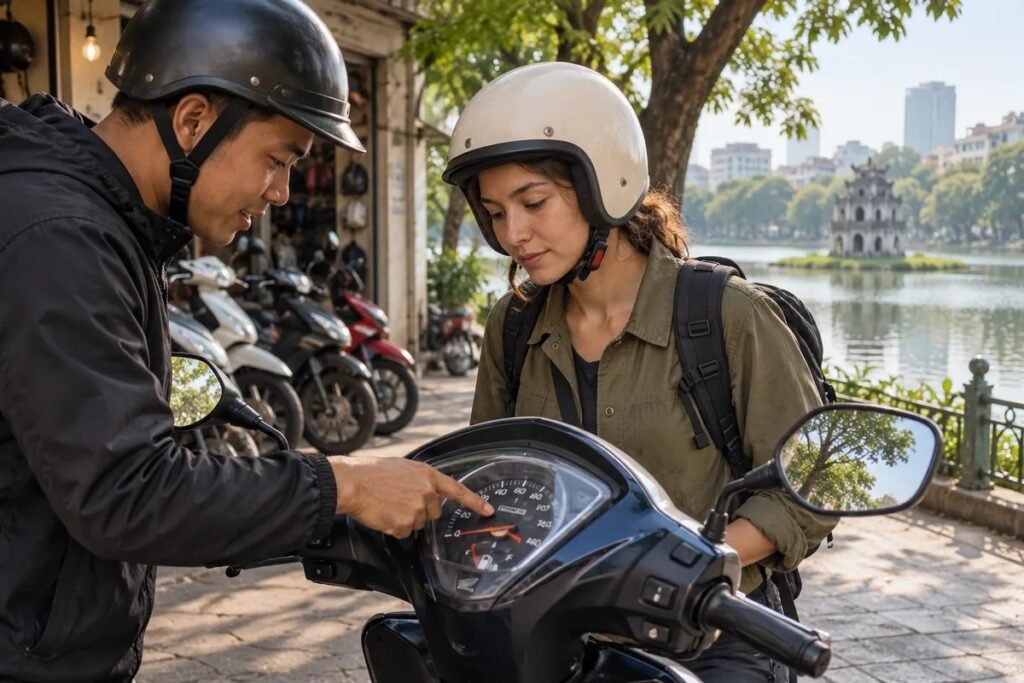
A factory idling-stop system intentionally turns the engine off under defined conditions, which is very different from a fuel-starved engine stalling unexpectedly. Do not treat an idling-stop event as proof that the tank is empty. If you do not understand the feature on an unfamiliar rental, ask for a demonstration at handover.
There is more detail in our idling-stop explanation for scooter renters. Equipment and operating behaviour still need checking on the exact vehicle.
Why low-fuel planning matters more on long journeys
Congestion, hills, luggage and passenger load affect the amount of fuel required. Maps may list a petrol station that is closed or inconveniently located. Before a trip into an unfamiliar area, identify more than one possible stop and refuel with a comfortable margin rather than waiting until the bike begins to hesitate.
There is no model-independent rule that a rider should refuel at exactly one quarter of a tank or that the low-fuel lamp leaves a fixed number of kilometres. Those may be personal planning cues, not certified manufacturer ranges.
Questions for the rental-shop handover
- Is this bike fuel-injected or carburettor-equipped?
- What petrol grade does the manufacturer specify?
- How does the fuel warning behave on this individual model?
- What should the renter do if the engine cuts out unexpectedly?
- Who should be contacted if the bike remains difficult to start after an appropriate refuel?
Do not remove fuel hoses, inspect wiring or detach the tank on a rental motorcycle. Even a simple-looking system can be dangerous to open without the right equipment and permission.
What if the motorcycle starts again after refuelling?
A normal restart may resolve a straightforward lack of petrol, but it does not prove why any earlier hesitation occurred. If rough running continues, new warning indicators appear or the engine stalls again, stop and describe the change to the shop. A renter should not be expected to verify fuel-pump health by carrying out a long test ride.
Takeaway for Hanoi renters
Refuelling before the tank is empty reduces the chance of an unwanted roadside stop and avoids unnecessary stress on a system whose design you may not know. It is sensible maintenance behaviour, not a claim that every empty tank causes immediate mechanical damage.
To view the current rental categories, see Nguyen Ha’s automatic scooter overview. For advice about the bike you actually have, contact 0334 699 969.