Riding Skills & Safety Planning
High Beam or Low Beam in Hanoi Traffic: What Riders Should Check
On this page
When should you use high beam and when low beam on a motorbike in Hanoi? Article 20 of Vietnam’s 2024 road traffic law says riders must switch from high beam to low beam when meeting pedestrians crossing, when riding through built-up areas with working street lighting, when meeting oncoming vehicles unless an anti-glare median separates you, and when turning at a junction. In practice, that means low beam on almost every lit city street in Hanoi. The headlight itself must be on from 18:00 to 06:00 and whenever fog, smoke, dust, rain or bad weather reduce visibility.
A rider dazzled by oncoming high beams is a hazard to everyone. This guide explains what the law requires, how it applies to Hanoi’s streets and what to do when someone else’s lights blind you.
When the headlight must be on
Article 20(1) of the consolidated Law on Road Traffic Order and Safety requires drivers and riders to switch on the front lights from 18:00 until 06:00 the next morning, and at any time when fog, smoke, dust, rain or bad weather limits visibility. Article 26 adds that motor vehicles must use low beam in road tunnels.
The four situations that require low beam
| Situation in Article 20(2) | What it means on a Hanoi ride |
|---|---|
| Meeting pedestrians crossing the road | Dip your lights at crossings and wherever people step out between vehicles |
| Riding through built-up areas with working street lighting | Most city streets after dark: use low beam as the default |
| Meeting oncoming vehicles, unless an anti-glare median separates the directions | Dip early when you see oncoming lights, even on wider roads |
| Turning at a junction | Use low beam while turning, so you do not sweep high beam across other road users |
Where high beam may help
High beam is useful on unlit roads with no oncoming traffic and nobody ahead, such as rural stretches outside the city at night. Even there, switch to low beam as soon as a vehicle appears ahead or a pedestrian is about to cross. The guide on scooter headlights on unlit roads helps you judge whether your bike’s beam reaches far enough for a late return.
In rain, mist or fog
Bad weather is one of the conditions in Article 20(1) that requires the headlight, but it is also when high beam works worst. In heavy rain, mist or fog, high beam reflects off the water droplets and creates a bright wall in front of you, while low beam stays closer to the road surface. Use low beam, slow down and leave a larger gap. If visibility drops so far that you cannot see the road clearly, stop in a safe place and wait.
Following another vehicle
High beam behind another vehicle shines into its mirrors and dazzles the rider or driver ahead, even if you are not facing them. Dip to low beam whenever you are close behind someone, and keep it dipped in slow city traffic. The same courtesy applies to cyclists and pedestrians walking along the edge of the road, who are easily blinded on unlit stretches.
Remember that a passenger or heavy luggage can raise the front of the bike and point the beam higher than usual. If you ride two-up at night, keep to low beam as your default and dip earlier than you would alone.
Know your switch before dark
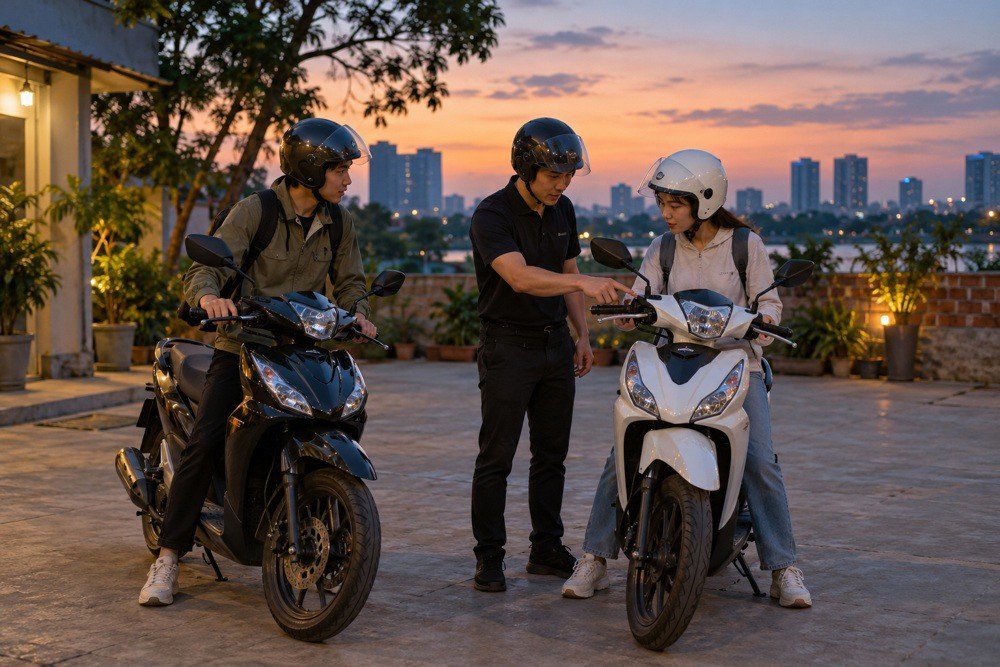
On most motorbikes, the beam switch is on the left handlebar, often with a separate button for flashing the high beam. Find it with the bike parked, check which symbol on the dashboard shows high beam is on, and practise switching without looking down. If the high-beam indicator stays lit when you think you have dipped, the switch may be faulty; report it to the shop.
When you are dazzled by oncoming lights
- Slow down and increase your distance from the vehicle ahead.
- Look towards the right-hand edge of your lane rather than into the lights.
- Do not close your eyes or turn your head away.
- Keep your helmet visor clean; scratches and dirt scatter oncoming light.
- Do not “retaliate” with your own high beam; it only makes both of you less safe.
The guide to night riding in Hanoi and oncoming dazzle covers which roads are better kept for daylight.
Flashing your headlight
Riders sometimes flash the high beam to warn or communicate. Use it sparingly, never as a way of demanding priority, and never in a way that dazzles people. The article on horns, lanes and flashing lights in Hanoi explains what such signals usually mean and their limits.
If your own headlight seems to dazzle people
If oncoming riders keep flashing at you while you are on low beam, your headlight may be aimed too high, especially with a passenger or luggage. Check it with a wall test and tell the shop rather than adjusting it yourself.
What the law does not settle
Article 20 lists situations rather than distances; it does not say how far ahead of an oncoming vehicle you must dip, or define how bright “working street lighting” must be. Use judgement and dip early. This article is general information, not legal advice.
Questions to ask when you collect the bike
- Where is the beam switch on this model, and which dashboard light shows high beam?
- Do the headlight, high beam and flash button all work?
- Is the headlight aimed correctly when riding with a passenger?
Message to send the shop
Hello Nguyen Ha, I am collecting the [model] on [date] and will ride after dark. Could you show me the high and low beam switch, and check that the headlight is aimed correctly for riding [alone / with a passenger]?
Frequently asked questions
Must I use low beam in Hanoi’s city streets at night?
Yes, in practice. Article 20(2) requires low beam in built-up areas with working street lighting, and most Hanoi streets are lit.
Do I have to dip my lights for oncoming traffic on a dual carriageway?
Yes, unless the median between the directions has an anti-glare function. When in doubt, dip.
What hours must my motorbike headlight be on?
From 18:00 to 06:00, and at any time when fog, smoke, dust, rain or bad weather reduces visibility, under Article 20(1).
Nguyen Ha Motorbike Rental: Ngõ 5 Nguyễn Văn Cừ, Bồ Đề, Long Biên, Hanoi, Vietnam, open 09:00–21:00 daily. Call +84 334 699 969 if your rental bike’s lights or switches are not working properly.