Riding Skills & Safety Planning
Stuck in a Hanoi Traffic Jam: Can You Ride on the Pavement or Against the Flow for a Few Metres?
On this page
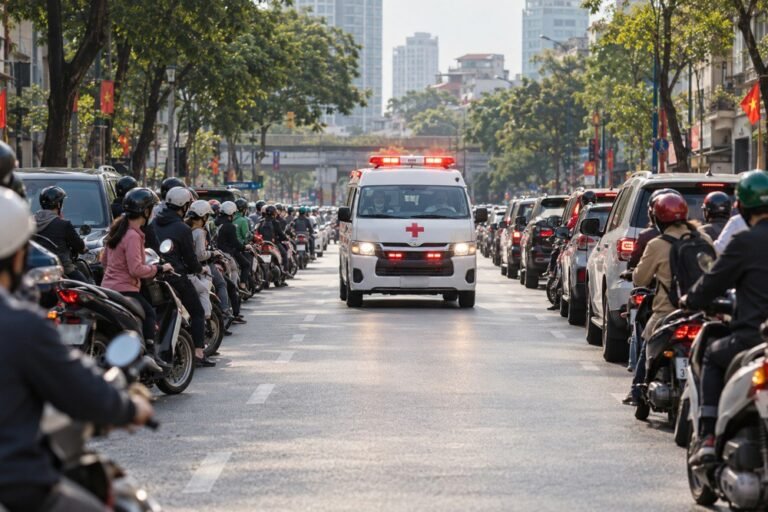
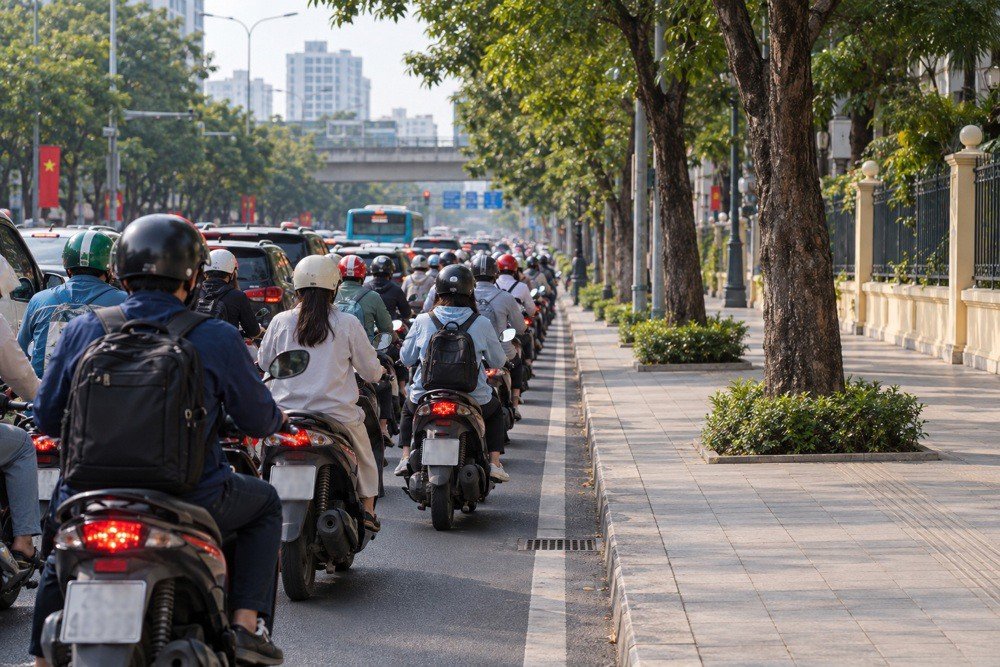
The traffic ahead has stopped, the pavement to your right is empty and the oncoming lane looks quiet. Is a few dozen metres on the pavement or against the flow allowed if you are stuck? No source treats a traffic jam as an exception. Decree 168/2024 fines motorbike riders 4,000,000–6,000,000 VND and deducts two licence points for riding on the pavement or riding against a one-way street, and a provincial police answer says that using the pavement to escape congestion is still penalised. The texts give no distance below which it is tolerated.
This guide reads Law No. 36/2024/QH15, Decree 168/2024/ND-CP, the amending Decree 238/2026/ND-CP, a Traffic Police Department notice and a Nghe An police Q&A. It reports what the pages say; it is not legal advice and it does not judge any particular situation.
What the law and the penalty decree say
Article 10(1) of Law No. 36/2024/QH15 requires road users to keep to the right in their direction of travel, use the correct lane and part of the road, and obey signs. Article 77(1) opens with a simple division: the roadway is for traffic and the pavement is for pedestrians.
The penalties for motorbikes sit in Article 7 of Decree 168/2024/ND-CP. Clause 7(a) covers riding against the direction of a one-way street or past a no-entry sign (except priority vehicles on an emergency call) and riding on the pavement (except crossing it to enter a house or building). Clause 13(a) adds a two-point licence deduction for clause 7(a).
| Behaviour in Article 7 | Clause | Fine in the decree |
|---|---|---|
| Riding against a one-way street or past a no-entry sign; riding on the pavement | 7(a) | 4,000,000–6,000,000 VND, plus 2 licence points |
| Ignoring a traffic officer’s directions | 7(d) | 4,000,000–6,000,000 VND |
| Riding outside the designated part of the road or lane (same-direction or opposite lane) | 3(d) | 600,000–800,000 VND |
| Stopping or leaving the bike on the roadway or pavement illegally; U-turning where it is banned | 2(d) and 2(k) | 400,000–600,000 VND |
The table shortens the decree’s wording, and we do not place any particular situation in any particular row. A Nghe An police Q&A (11 July 2026), answering a reader who asked about mounting the pavement to avoid a jam, gives the same 4–6 million VND and two points and says that using the pavement to get round congestion is still penalised. For how the points system works, see our guide to Vietnam’s licence points system.
Which version of the decree applies
The National Legal Database shows Law 36/2024 as in force and Decree 168/2024 as partly superseded. Decree 238/2026/ND-CP, issued on 26 June 2026 and in force from 15 August 2026, amends parts of Decree 168; the Traffic Police Department announced it on 15 August 2026. Article 21 of Decree 238 says that for a violation committed and completed before that date but discovered or handled later, the decree in force at the time of the violation applies. Decree 238 touches Article 7 of Decree 168 in two places, on changing lanes and on restricted areas and roads.
The moves the law describes instead
Article 11(2) sets the order of precedence: a traffic officer’s directions first, then traffic lights, then signs, then road markings. The options below are what the law describes; they do not tell you whether the spot where you are stuck allows them.
- Stay in your lane. Article 12(1) requires you to respect speed rules and keep a safe minimum distance from the vehicle ahead in the same lane. Our guide to following distance in stop-and-go traffic explains how much space to leave.
- Move to the next lane. Article 13(2): on roads with several marked lanes in one direction, change lanes only where allowed, one adjacent lane at a time, signalling in advance and watching ahead, behind and to both sides.
- Turn off. Article 15(2): observe, slow down, signal and move gradually into the lane nearest your turn; Article 15(3): give way to pedestrians, non-motorised vehicles and oncoming traffic.
- Turn around, except where Article 15(4) bans it: on bridges, in tunnels, on narrow roads, slopes and one-way streets, among other places, unless an officer or a temporary sign directs otherwise. The law has no list of places where U-turns are allowed.
- Follow the officer. Article 9(4) prohibits ignoring the directions of officials on traffic duty, and Article 78(2)(a) says traffic police manage congestion by directing traffic and dealing with violations.
What not to do
- Do not treat “a few dozen metres” as an exception. Neither clause 7(a) nor clause 3(d) mentions a distance. The only pavement exception in clause 7(a) is crossing it to enter a house or building; the only wrong-way exception is a priority vehicle on an emergency call.
- Do not park the bike on the pavement to wait for the jam to clear. Clause 2(d) covers stopping or leaving a vehicle on the roadway or pavement illegally; we do not decide which places count as illegal.
- Do not follow other riders onto the pavement because they are doing it. The fine and points apply to each rider.
When you are stuck and need to decide
- Look at the lights, signs and road markings where you are. If an officer is directing traffic, follow the officer first, because those directions take precedence.
- If you want to change lane or turn, signal and check ahead, behind and to both sides.
- If you are unsure (our suggestion, not a source’s), stay in your lane and keep your distance from the vehicle in front.
- If you are stopped by an officer (also our suggestion), note the time, street name and signs, and keep a photo of any paperwork you are given so you can show the shop. Our guide to being stopped by traffic police covers what to have ready.
If the bike is held as part of a penalty, see what to do when a rental bike is impounded.
What the sources do not say
- No page treats a traffic jam or congestion as an exception for riding on the pavement or against the flow; the Nghe An answer says the opposite.
- No page gives a length of road over which this is allowed; the phrase “a few dozen metres” appears nowhere.
- No page deals specifically with alleys, rental bikes or visitors.
- No page places a specific case, such as riding a short way in the opposite lane of a two-way street, under clause 3(d) or clause 7(a); we do not choose.
- We did not read a consolidated version of Decree 168 with the 2026 amendments, or any Hanoi-specific rule.
- The Nghe An article is an answer to a reader, not a legal text.
Sources checked
- Law No. 36/2024/QH15, National Legal Database, updated 29 March 2026: vbpl.vn
- Decree 168/2024/ND-CP, signed 26 December 2024, page updated 15 August 2026; Article 7 fine and points re-checked on 18 November 2026: vbpl.vn
- Decree 238/2026/ND-CP, signed 26 June 2026, in force 15 August 2026, as reported by the Traffic Police Department and VOV
- Nghe An Provincial Police, Q&A on mounting the pavement, 11 July 2026: congan.nghean.gov.vn
Message to send the shop
Hello Nguyen Ha, I was stopped by traffic police at [place] at [time] on [date] and was given [describe paperwork]. I have taken photos of it. What should I do next, and do you need anything from me?
Frequently asked questions
Is it legal to ride on the pavement in Hanoi to get past a jam?
No source treats a jam as an exception. Decree 168/2024 lists riding on the pavement, apart from crossing it to enter a building, at 4–6 million VND with two licence points.
What about riding a short distance against a one-way street?
The same clause covers it, with no minimum distance. The only exception named is a priority vehicle on an emergency call.
Can I turn around to get out of the jam?
Only where U-turns are not banned. Article 15(4) lists places such as bridges, tunnels, narrow roads, slopes and one-way streets where you may not turn, unless an officer or a temporary sign directs you to.
Nguyen Ha Motorbike Rental: Ngõ 5 Nguyễn Văn Cừ, Bồ Đề, Long Biên, Hanoi, Vietnam, open 09:00–21:00 daily. Call +84 334 699 969 if you are stopped while riding a rental bike.