Riding Skills & Safety Planning
Turning Left Across Hanoi Traffic: Scan, Signal and Wait for a Gap You Can Trust
About 6 minutes to read
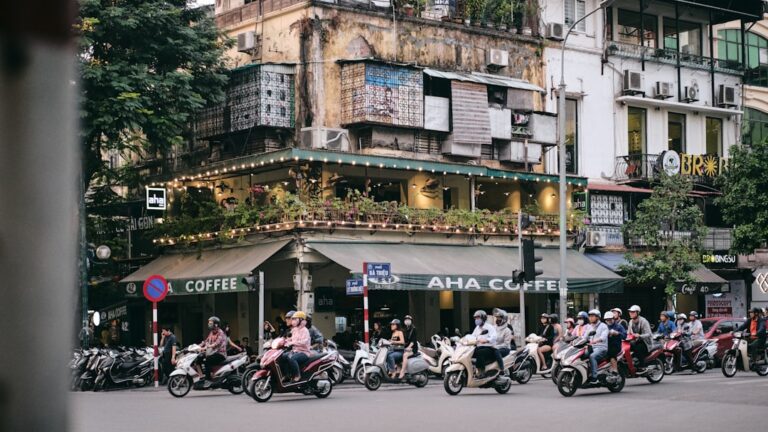
A visitor on a rental scooter who reaches a wide junction and needs to go left faces a different problem from a straight run: when there is no separate turn phase to clear the road first, the bike has to cross the path of vehicles coming the other way. The pull to follow the rider ahead into a narrow opening can feel strong, yet that rider knows their own machine, and their timing rests on it. This article sets out a plain method for the turn: scan, signal, take position, hold back until the gap is one you can finish, then pull away smoothly. It also covers the mistakes to avoid, how to respond when the turn goes wrong, and what to put to the shop. The rental shop’s instructions and any manual for the bike take precedence over this general guidance.
Why crossing the oncoming stream asks more of a rider
A turn that stays with the flow has fewer things to go wrong than one that cuts across it. Three problems arrive together: vehicles approaching from ahead whose speed is hard to read, vehicles behind that may expect you to keep moving, and a stretch of open road where the bike is exposed while it crosses. A narrow motorbike on the oncoming side can hide behind a bus, a truck or a car, so a gap that looks empty at first glance may not be.
Scan before you commit
Begin the scan well before the junction, so that no single check has to be rushed.
- Look far ahead first: the layout of the junction, the exit road you want, and whether its entrance is clear or filling up.
- Glance at the mirrors to learn what is close behind and whether anyone is about to pass you.
- Turn your head briefly toward the side of the turn, once the bike is steady, to cover the space a mirror leaves out.
- Bring your eyes back to the oncoming vehicles and any pedestrians, reading what each one is doing rather than glancing once.
A mirror glance is a check, not an adjustment, so set both mirrors before leaving the shop. Motorbike Mirror Blind Spots: Set a Stationary Reference Before Departure covers setting a stationary reference for the areas the mirrors do not show.
Signal and take your position
Switch the indicator on early enough for those behind to read it, then move toward the side of your lane that matches the turn, staying inside the markings and the road layout in front of you. Some bikes do not cancel the indicator by themselves, so switch it off once the turn is complete if your bike needs that.
| Bike type | While waiting at the junction | Pulling away |
|---|---|---|
| Automatic scooter | Neither clutch nor gear lever to manage. Keep a brake applied so the brake lamp shows behind you, with the front wheel held straight. | Roll the throttle on gradually; a sudden twist can make the bike lurch. |
| Semi-automatic underbone | Gears are changed by foot, with no clutch lever. Hold the brake and set the gear for pulling away the way the shop or the manual shows. | Open the throttle smoothly and leave any gear change until the bike is straight again. |
| Manual motorbike | Clutch lever pulled in, first gear selected, brake applied. | Let the clutch lever out gradually as the throttle opens, and change gear only after the turn. |
How the controls differ in stop-start conditions is the subject of Automatic vs Semi-Automatic in Stop-Start Hanoi Traffic: A Control Comparison, a comparison of how each type is operated.
Wait for a gap you can trust
A gap you can trust is one you could cross completely, at a pace the bike holds without strain, with room left over after you clear the oncoming lane, and with an exit that is empty.
| What you see | What it may mean | Response |
|---|---|---|
| An oncoming vehicle that looks small and slow | Seen head-on, a distant vehicle can seem to creep, so its real approach may be quicker | Assume it is closer than it looks and let it pass |
| A bus or truck on the oncoming side | A smaller vehicle may be travelling beside it, out of sight | Wait until you can see past it |
| Another road user waves you across | A hint about that one vehicle, and no promise about the rest of the road | Make your own check before moving |
| The entrance to your exit road is filling up | You could end up stopped in the middle of the junction | Wait for room for the whole bike plus a margin |
A rental bike you have only just collected may pick up speed differently from the one you know, so learn how it responds at quiet junctions first.
Build the skill in steps
- Begin on a quiet side road in daylight, where oncoming vehicles are few enough for you to name each one.
- Rehearse the scan on its own while riding straight through a junction, with no indicator on, until the sequence needs no thought.
- Turn only when the road is clear in both directions and the exit is empty, so your attention stays on pulling away smoothly.
- Add traffic gradually, keeping a wider margin than seems needed.
Motorbike Riding Tips for First-Time Riders offers tips for first-timers on a motorbike.
What not to do when crossing oncoming traffic
- Do not follow another rider through a gap because they made it; their bike, weight and reactions differ from yours.
- Do not angle the front wheel toward the turn while waiting, because a push from behind would send the bike into the oncoming path.
- Do not enter the junction when the exit is blocked and you would have to stop halfway.
- Do not read a phone or map screen on the approach, while waiting or mid-turn; plan the route before moving off.
- Do not fix your eyes on an oncoming vehicle once you are moving; keep checking it in passing, but look mainly toward the exit, because it is easy to steer toward whatever you stare at.
If a gap closes or the bike stalls mid-turn
Plans go wrong, and a small, calm response works better than a sudden one.
- A vehicle that appears faster than you judged, before you have left the waiting position: stay put with the brake held and let it go by.
- A gap that shrinks when you are already part-way across: keep the inputs smooth, and choose the action that takes the bike out of the other vehicle’s path, either a steady throttle to finish the turn or a gentle, progressive brake if the bike is not leaning hard and there is clear room to stop outside that path.
- An engine that stalls: hold the brakes, put your feet down, then restart the way the shop or the manual describes. If it will not restart or behaves oddly, show the hazard lights if the bike has them, move it clear of the traffic as soon as it is safe to do so, switch off, and leave every part as it is; do not dismantle or force anything. Photograph the bike and note what happened, then tell the shop.
- A fall, a collision, smoke or an injury: if you can do so safely, move yourself clear of traffic and away from the bike, call for emergency help, and only then document the scene and contact the shop.
Questions to ask the shop about junction turns on this bike
- Does the indicator on this bike switch itself off after a turn, and which thumb operates the switch?
- Can the staff demonstrate how this bike pulls away from a standstill, so that you can judge its pickup before facing a wide junction?
Thuê xe máy Nguyễn Hà is open 09:00–21:00 daily at Ngõ 5 Nguyễn Văn Cừ, Bồ Đề, Long Biên, Hà Nội (near Gia Lâm bus station). Phone: 0334 699 969.