Fuel & Running Costs
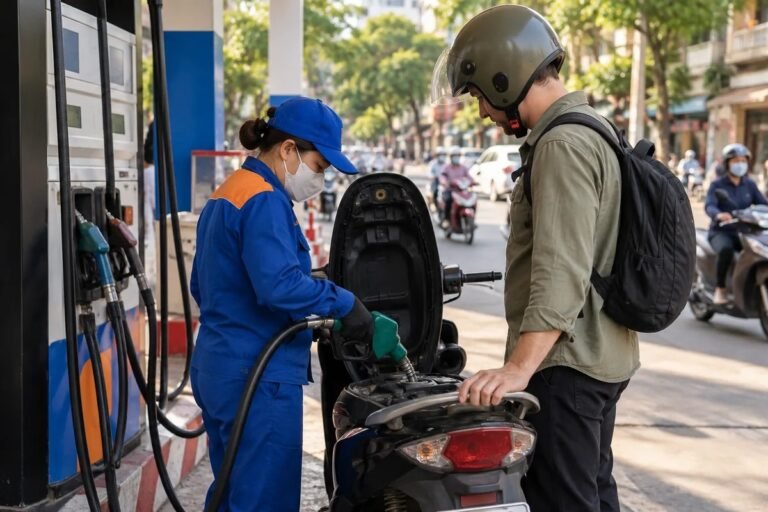
Long Gaps Between Petrol Stations: Plan Safe Refuelling Stops
On this page
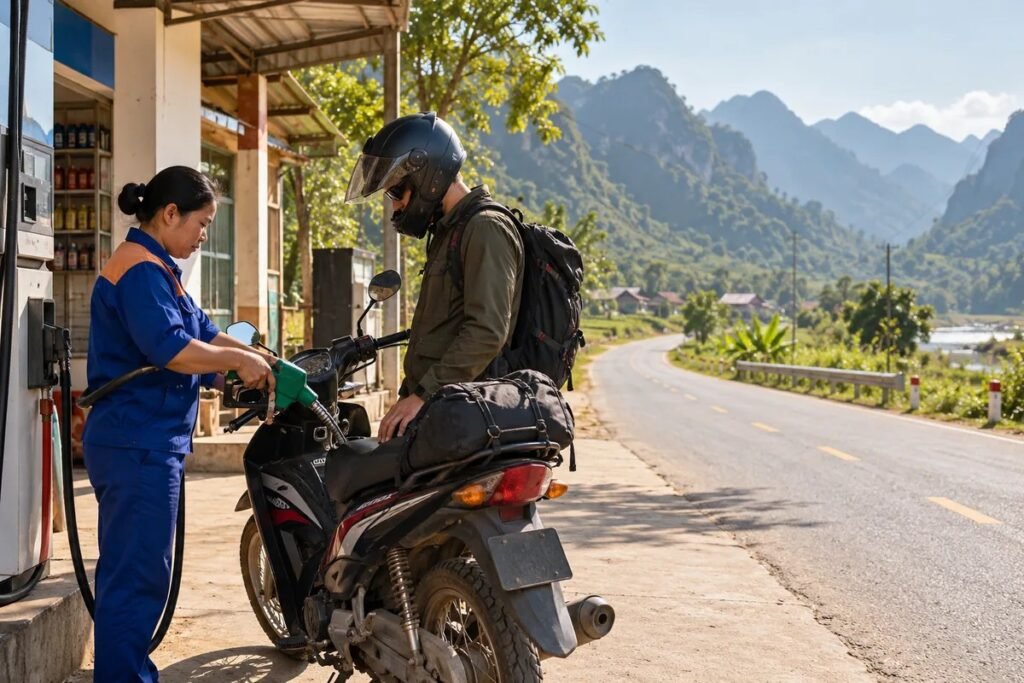
How do you plan fuel stops on a motorbike route with long gaps between petrol stations? Pin every station along the route before you leave, measure the longest gap between two of them, refuel fully at the last station before that gap, and decide in advance at which point you will turn back if fuel is lower than planned. Do not wait for the fuel warning light before thinking about petrol, and do not rely on carrying spare fuel in a bottle or can.
Riverside roads, mountain passes and rural loops north of Hanoi can include stretches where stations are far apart, closed in the evening or not where the map says. Four simple planning steps turn that uncertainty into a clear plan.
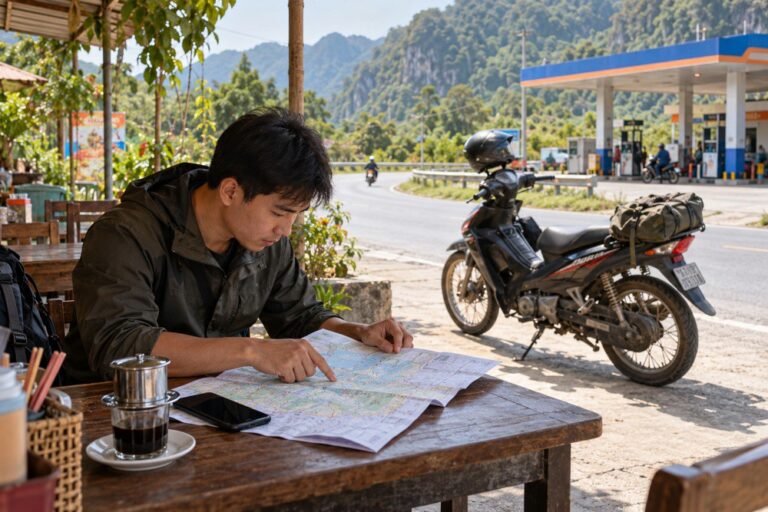
Step one: pin the refuelling points
- Open your map app and search for petrol stations along the whole route, from start to finish, including the way back if it differs.
- Save each station to a dedicated list, named in the order you will reach them.
- Cross-check each one: satellite view, recent reviews and listed opening hours. Where possible, confirm important stations by phone or ask locals on the day.
- Download offline maps for the area, because mobile coverage can be weak in sparsely populated sections. The guide on downloading offline maps before a day trip explains how.
- Write the key stations on paper or keep screenshots, in case your phone battery runs out.
Step two: measure the gaps
For each pair of consecutive stations, note the distance between them. The most important number is the longest gap on the route, because that is the stretch where a mistake costs the most. Also note sections where the road climbs, the surface is poor or you expect heavy traffic, as these use more fuel.
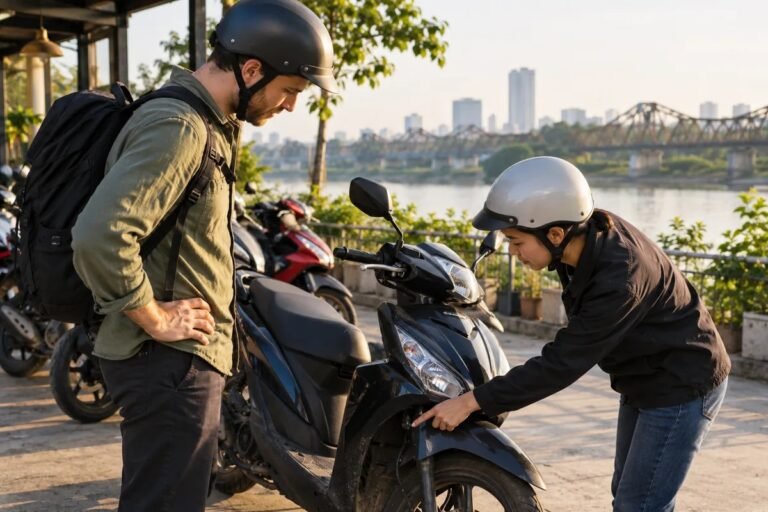
Ask the rental shop how far the specific bike usually goes on a full tank in normal riding, and treat any figure as an approximation. A bike carrying a passenger and luggage uphill will not match a figure quoted for flat, solo riding.
Step three: set your must-refuel rules
| Situation | Suggested rule |
|---|---|
| A confirmed station is close ahead | You may wait for it if the gauge has a margin, but do not let the warning light be your reminder |
| A long gap with no stations is ahead | Fill up at the last station before the gap, even if the gauge is not low |
| Mid-route, unsure whether the next station is open | Refuel at the station you are passing; do not gamble on one you have not confirmed |
| Climbs, headwind or a heavy load | Expect higher consumption and refuel earlier than usual |
A rule worth remembering: never wait for the fuel light to come on before you start thinking about the next station. Ask the shop at pickup how the low-fuel warning works on your bike, if it has one, and remember that a warning is not a precise distance counter.
Step four: set a turnback point
- Choose a decision point on the route, such as the last place from which you can comfortably ride back to a confirmed station.
- Set a threshold for that point: for example, if the gauge is below half a tank when you reach it and the next station is not confirmed, you turn back or take a shorter route.
- Tell the whole group before you set off. When several bikes ride together, consumption differs, so the threshold should be based on the bike with the least fuel.
- Do not be embarrassed to turn back. Losing an hour costs far less than pushing a bike with an empty tank along a remote road.
For day trips from Hanoi in particular, the guide to choosing the last petrol station and setting a reserve applies the same idea to a round trip.
If the fuel light comes on before you reach a station
- Slow down and use the throttle gently. Smooth, steady riding uses less fuel than accelerating hard and braking.
- Stop somewhere safe and check the map for the nearest station, including any behind you.
- Ask local people where the nearest proper petrol station is and whether it is open now.
- Call the rental shop if you cannot find anywhere to refuel. Ask at booking what kind of help is realistically available on your route.
What not to do
- Do not carry petrol in a can or bottle on the bike. It can leak and catch fire; see the risks of carrying spare petrol and plan stops instead.
- Do not trust the fuel gauge completely, especially near the bottom of its range.
- Do not push on “to get there” when the light is on and no confirmed station is ahead.
- Do not ride remote roads after dark without knowing whether the stations ahead are still open.
Riding as a group
Different bikes have different tank sizes and consumption, so the group’s refuelling rule should follow the bike that runs low first. When one bike stops for fuel, the whole group stops. On sparse sections, carry some cash, because a few small stations may not accept card or app payments.
If one bike starts running much lower than the others, do not split up. Slow down together and head for the nearest confirmed station as a group.
Before you set off
- Fill the tank at the start of a long route, even if it does not seem necessary yet.
- Photograph the fuel gauge at pickup and ask how fuel is handled at return.
- Save the shop’s number and the addresses of the main stations in your phone, and write them down too.
- Check with the shop that your planned route is permitted for the bike; Nguyen Ha’s rental policy asks riders to agree repair arrangements before authorising work on breakdowns outside Hanoi.
Message to send the shop
Hello Nguyen Ha, I am planning a ride from Hanoi to [destination] via [route] on [date]. Some sections seem to have few petrol stations. Could you tell me roughly how far the [model] goes on a full tank in normal riding, how its low-fuel warning works, and what I should do if I cannot find fuel on that route?
Frequently asked questions
How far can a rental scooter go on a full tank?
It depends on the model, load, road and riding style. Ask the shop about the specific bike and treat any figure as an estimate, not a guarantee.
Should I carry a spare can of petrol on a long trip?
No. Improvised fuel containers are a fire and leak risk. Plan refuelling stops and turnback points instead.
What is a turnback point?
A place on the route, chosen in advance, where you check the fuel level and turn back or shorten the route if it is below the level you set.
Nguyen Ha Motorbike Rental: Ngõ 5 Nguyễn Văn Cừ, Bồ Đề, Long Biên, Hanoi, Vietnam, open 09:00–21:00 daily. Call +84 334 699 969 before riding a route with long gaps between petrol stations.