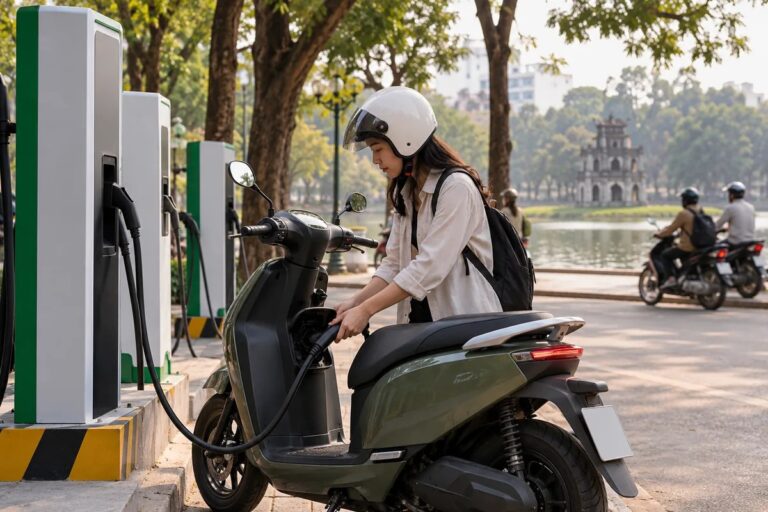
Electric & 50cc Options
Public Charging for a Rental Electric Scooter in Hanoi: Plug Type, Permission and Who Pays
About 7 minutes to read
The battery is getting low, you are far from where you usually charge, and there is a public charging point by the road. Can you plug the rental scooter in? There is no single answer, because three separate questions sit behind it: whether the plug and power supply match the bike, whether you are allowed to use that point with this bike, and who pays. Each needs checking in a different place. This guide splits those questions apart, suggests what to ask the shop before you set off, how to record the answers and what to do when the battery runs low before you have them. It does not say which scooters work with which chargers, whether a particular shop rents electric scooters or where it allows charging, and it does not replace the maker’s documents.
The short answer
Do not plug a rental electric scooter into a public charger just to see whether it works. Before the trip, ask the shop how this bike charges, whether you may use outside charging points, which ones, and who pays. At the charging point, read the operator’s instructions on which vehicles it accepts and how payment works. If both the shop and the operator have not said yes, do not plug in. Photograph the receipt or screen afterwards and send it to the shop the same day.
Three questions to keep apart
| Question | What it means | Who can answer |
|---|---|---|
| Compatibility | Do the plug, the type of supply and the power of the charging point match the bike? | The shop and the maker’s documents |
| Permission | Does the shop allow outside charging, and does the charging point accept this kind of vehicle? | The shop and the operator of the charging point |
| Cost | How the charge is priced, how it is paid and who bears it | The shop and the information at the charging point |
Some charging points are built for other kinds of vehicle, and two plugs that look alike do not necessarily carry the same supply. That is why “just try it” is not a safe approach. Some electric scooters also run on swapped batteries rather than plug-in charging; battery swap versus plug-in explains the difference for renters.
Ask the shop how the bike charges
- Does this scooter charge through a socket on the bike, or only through the supplied charger plugged into a wall outlet?
- If it has a charging socket, what type of plug is it, and where in the maker’s documents is that stated? Photograph the socket and any label near it so you can compare later.
- Should you carry the supplied charger on longer rides?
- Are there any charging points or plug types you must not use with this bike?
- Does the bike use a removable or swappable battery, and if so, may you take it anywhere to charge or swap?
Permission: confirm it in two places
- Ask the shop before the trip and ask it to reply in writing, so you are not relying on memory later.
- At the charging point, read the operator’s instructions: which vehicles it accepts, how to register and how to pay.
- If the point needs an app or an account, read the operator’s terms before you enter personal details or card information.
- Until you have a clear yes from both the shop and the operator, do not plug in.
Who pays: settle it before you plug in
Small charging fees are easy to forget unless you record them at once. Three habits help:
- Ask whether outside charging is at your own cost or refunded by the shop, and if refunded, how.
- When charging finishes, photograph the screen or receipt showing the location, start and end time, energy delivered and amount paid.
- Send the photos to the shop the same day rather than waiting until you return the bike.
Operators may charge by time connected or by energy delivered, so note both if the screen shows them. The wider cost picture, from electricity tariffs to swap fees, is covered in electric scooter running costs in Hanoi.
A message to the shop can be as simple as: the bike needs a charge, I am at a charging point because the battery is low; may I use this point with the bike, and how is the fee handled? Add the plate number, the name of the charging point and the battery reading.
What to record after any outside charge
| Record | How | Why |
|---|---|---|
| Battery level before and after | Photo of the display | Shows what the charge achieved |
| Charging point name and location | Photo of the sign or a map pin | Lets the shop check the point it approved |
| Time connected and energy delivered | Photo of the screen or receipt | Matches the way the fee is calculated |
| Amount paid and payment method | Receipt or app history | Needed for any refund |
| Anything unusual | Photo and a short note | An error, heat or smell should be reported at once |
If the battery runs low before you have an answer
- Ride gently and steadily with the traffic, keep your distance, and drop any extra stops.
- Stop somewhere safe before looking at your phone or a map; never look at the screen while the bike is moving.
- Call the shop and ask before plugging in anywhere.
- If the battery is nearly flat and you still have no answer, wheel the bike to the side, switch on its hazard lights if it has them, photograph the location and the battery reading, and ask the shop for the next step.
- Once a charging point has been approved, check the plug and cable before connecting: no cracks, no water, no burning smell. If anything looks wrong, do not connect, and tell the shop.
Before a day trip on an electric scooter
Most low-battery problems start with a plan that assumed a charge would be easy to find. Before you leave:
- Start with a full charge and photograph the battery reading at departure.
- Compare the round-trip distance with the range the shop expects for this bike in real riding, not the brochure figure, and keep a margin for hills, a passenger and stop-start traffic.
- Agree with the shop in writing where you may charge on the way, if anywhere, and who pays.
- Save the shop’s number and the address of your accommodation where you can find them without a charged phone.
- Decide in advance the battery level at which you will turn back.
Where you are and what to do
| Situation | Sensible next step |
|---|---|
| Battery fine, approved charging point on the route | Charge there if convenient, record it, and send the receipt the same day |
| Battery low, charging point in sight but not approved | Stop safely, message the shop with the point’s name and your battery reading, and wait for an answer |
| Battery low, no answer from the shop | Ride gently towards your base or a safe stopping place; do not plug in on guesswork |
| Battery nearly flat | Pull over safely, photograph the location and display, and ask the shop what it wants you to do |
| Charger or bike shows an error, heat or smell | Stop charging only if it is safe to do so, step away, and call the shop |
What not to do
- Try several plug types to see which one fits.
- Use extension leads, home-made adaptors or a stranger’s charger.
- Charge when the socket, the plug or the bike is wet; see a wet charger connector.
- Let a stranger remove the battery or work on the charging socket.
- Walk away straight after plugging in at an unfamiliar point, before checking that neither the bike nor the charger shows an error.
- Pay at the charging point first and ask who bears the cost afterwards.
Frequently asked questions
Can any public charger be used with a rental electric scooter?
No. The plug, supply and power must match the bike, the operator must accept that kind of vehicle, and the shop must agree. Check all three before plugging in.
Who pays for charging away from the shop?
That depends on what you agree with the shop. Ask before the trip and keep receipts or screenshots of every outside charge.
Should I take the supplied charger on a day trip?
Ask the shop. If the bike charges only through its own charger, carrying it may be the only way to charge away from base, but only use it where the shop says you may.
What should I do if the charger or socket looks damaged?
Do not connect it. Photograph it and tell the shop; a damaged plug or cable is a reason to stop, not to test.
Thuê xe máy Nguyễn Hà is at Ngõ 5 Nguyễn Văn Cừ, Bồ Đề ward, Long Biên, Hanoi (near Gia Lâm bus station), open 09:00–21:00 every day. Electric scooter rental is priced by model on request; ask about charging arrangements when you book, or call or message 0334 699 969. When you bring the bike back, agree and record the battery level at return as well.