Riding Skills & Safety Planning
Rusty on a Motorbike? Decide Honestly Whether to Rent in Hanoi After Years Away From Riding
About 6 minutes to read
If you have not ridden a motorbike in years, Hanoi is a demanding place to start again, but it is not an impossible one. The honest answer to “should I rent?” is neither a flat yes nor a flat no: it depends on how much of the skill is still in your hands, whether you give yourself a practice period before the busy streets, and how willing you are to wait a few days if the practice goes badly.
Three questions to answer before you book
1. How rusty, exactly?
“Years away from riding” covers very different people. A table makes the difference clearer.
| Your riding history | What it usually means for a first week in Hanoi |
|---|---|
| Rode a small scooter as a teenager, nothing since | Treat yourself as a beginner: expect to relearn balance, braking and traffic judgement |
| Rode regularly for years, then stopped for several years | The skills may return quickly, but your road judgement is out of date; practise before busy streets |
| Ride at home on a different kind of bike, such as a large manual motorcycle | The basics are there, but a small automatic scooter handles differently; the traffic is the real change |
| Only ever sat on the back | You are a first-time rider; read a beginner guide and plan a proper practice session |
2. Can you do the basics on demand?
Answer honestly from memory now, then confirm in your first half hour with the bike, on a quiet street or in a car park. Can you balance and steer smoothly at walking pace? Can you start and stop smoothly several times in a row, without a lurch? Can you stop smoothly in a straight line using both brakes? Can you make a full U-turn on a narrow lane? If any answer is “not reliably”, you are not ready for dense traffic yet, and that is useful information, not a failure. The first minutes after pick-up are also traffic, so decide where you will practise before you collect the bike.
3. What will your first ride really be like?
Think about the first journey you have in mind. Is it a short loop on a wide, quiet road, or does it start in the middle of the Old Quarter at rush hour? Will you be carrying luggage, or a passenger? Is it dry, in daylight and early enough that you are not tired? The same rider can handle one of these and be overwhelmed by another. If your first plan is the hardest version, change the plan, not the standard.
A practice period, not a leap
A sensible way to return is to treat the first hour as practice, not travel. Two things fade differently after years away: the physical skills (balance, braking, slow turns), which come back with repetition in an empty place, and road judgement (reading gaps and other riders), which needs fresh time in light traffic at low speed. The plan below trains them in that order:
- The first half hour: a quiet side street or a large car park. Repeat the basic checks above until they feel automatic.
- The next hour: a short loop on a quiet road with light traffic, in daylight. Practise looking over your shoulder, using the indicators early and judging gaps.
- The first full day: a short, simple route you have looked at on a map in advance. Avoid rush hour, rain and night riding.
- After that: add one new difficulty at a time, such as a longer route, a busier junction or a passenger.
It also helps to choose an easy bike for the first days. An automatic scooter has no clutch and no gears, so there is less to do with your hands and feet while you relearn balance and traffic. Make sure you can sit with both feet near the ground, that the mirrors show what is behind you, and that you know where the brakes, horn, lights and stand are before you leave. Check the helmet fits too; the guide to helmet fit at motorbike pickup has a strap and size checklist.
What Hanoi asks of a rider that riding at home may not
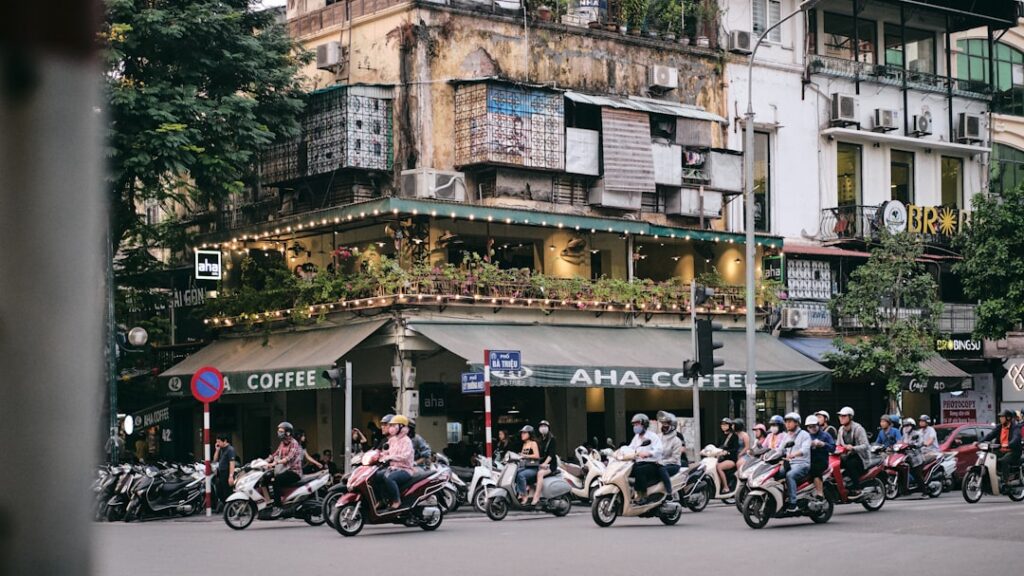
Even confident riders find the first hours in Hanoi unusual. Traffic moves as one wide stream of mixed vehicles at similar, fairly low speeds rather than in tidy lanes, and people merge by small negotiations such as a slight change of speed or a glance, not by strict right of way. Horns are mostly informational: they usually mean “I am here”, not anger. You will be passed on both sides, and a steady line and a steady speed are safer than swerving to make room. At junctions without lights, slow down, hold a steady line and be ready to stop; do not assume others will give way. None of this is a reason not to ride, but it is a reason to practise first.
Signs you should not rent yet
- You wobble at walking pace.
- You brake suddenly or grab the lever when something surprises you.
- You cannot judge gaps between vehicles or keep a steady line.
- You feel anxious about the first ride and cannot say what you would do if you felt unsafe.
- You are unwilling to practise, or you plan to start in the hardest traffic.
- You are very tired after a long flight, or you have been drinking.
If any of these apply, wait. If you are very tired or have been drinking, do not ride today. You can always rent later in the trip, once you have seen the traffic for a few days and decided how confident you feel.
Other ways to get around while you decide
Not renting on day one does not mean not renting at all. Ride-hailing apps, taxis, walking and local buses cover most central areas, and you can mix them: use an app for the first two days while you watch how people ride, then collect a scooter once you know where you will practise. If you are not sure at all, a day in a car with a driver is another way to see the outskirts without riding yourself.
What to ask the shop
When you contact the shop, say plainly that you have not ridden for a long time. Ask which bike they would recommend for a rusty rider, whether the seat height suits you, and whether they can show you the controls before you set off. If you would like to ride a few gentle laps near the shop before committing, ask whether that is possible; do not assume it. Ask too for the quietest way from the shop to a place where you can practise, and what the options are if you decide the bike is not for you; do not assume a refund or an exchange.
For more on the basics, read motorbike riding tips for first-time riders and 50cc motorbike rental in Hanoi for beginners, and browse the Riding Skills & Safety Planning category.