Luggage, Equipment & Navigation
Carrying a Small Pet on a Rental Motorbike: What to Ask the Shop
On this page
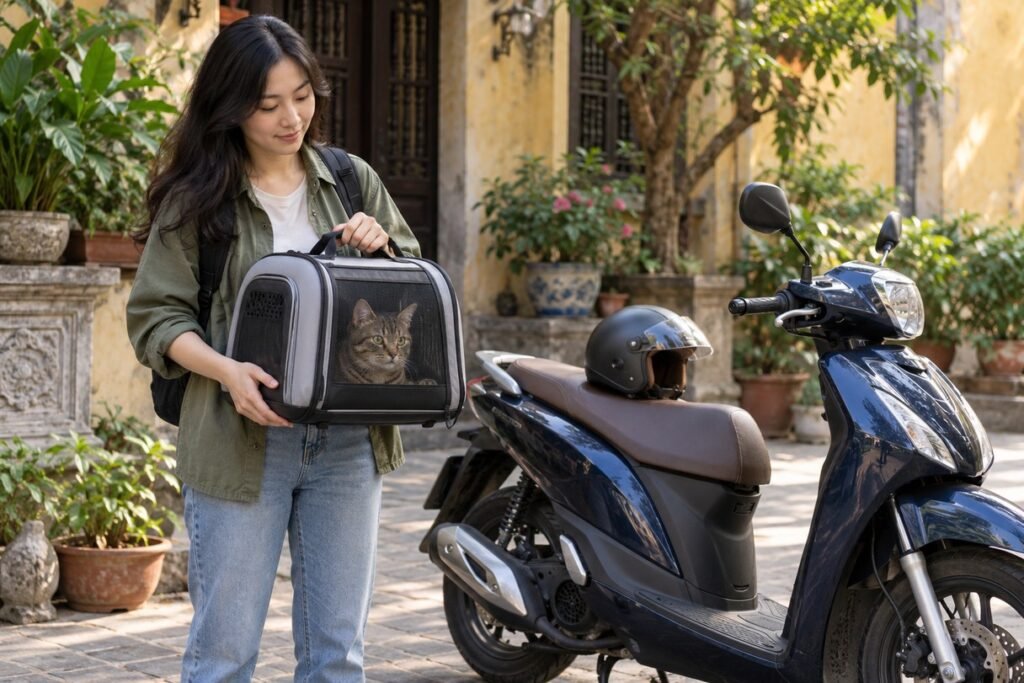
Need to take a cat to the vet or a small dog across Hanoi, and the only vehicle you have is a rental motorbike? Plan three things before you ride: a closed carrier the animal cannot push open, a position on the bike that does not stop you riding steadily, and a way to keep the seat free of fur and scratches. Above all, ask the shop first whether the bike may be used to carry a pet at all. That is the shop’s decision, and this guide cannot make it for them.
The guide covers choosing a carrier, the limits of each place you could put it, preparation, what to do if the animal panics, and the questions to ask the shop. It is not veterinary advice; ask a vet before moving an animal that is ill, recovering from surgery or prone to travel sickness.
Choose a carrier made for the journey
- Closed and secure: a zip or latch the animal cannot push open from inside.
- Ventilated: mesh panels or air holes on more than one side, especially in hot weather.
- The right size: room to stand up and turn round, but not so much space that the animal slides about when you brake.
- An absorbent pad in case the animal wets the carrier or is sick on the way.
- An inside tether clipped to a chest harness rather than a collar, so a struggling animal is not choked.
- Sturdy handles and no loose straps that could catch in a wheel.
Where the carrier could go, and the limits of each option
None of the options below is a confirmed safe way to carry an animal. Holding a bag on a lap, putting it on the floorboard or wearing a backpack carrier does not remove the risk of the animal wriggling, escaping or getting in the way of the controls. Only consider an arrangement that the vehicle maker, the carrier maker and the shop all accept, that does not overload the bike and that leaves riders able to hold on and place their feet. If you cannot confirm that, choose a vehicle where the carrier can be fixed in place.
| Position | Advantage | What to watch |
|---|---|---|
| Passenger holds the carrier on their lap or against their chest | Someone watches the animal the whole way, and the carrier takes fewer jolts | The passenger still needs to hold on, so the carrier must be small and the passenger seated securely |
| Passenger wears a backpack carrier | Leaves the passenger’s hands free to hold on | A wriggling animal can pull the passenger off balance; only suits light animals |
| Rider wears a backpack carrier when riding alone | The carrier stays close to the body and does not need tying on | Extra weight on the rider’s shoulders, and movement behind your back can distract you |
| On the floorboard of a scooter | Low and close to the bike’s centre of gravity | Only if the carrier fits, does not catch your feet when you stop, does not obstruct the handlebars and is kept from sliding |
| Tied onto the rear seat or a luggage rack | Nobody has to hold it | You cannot see the animal and a soft carrier shifts easily; only consider a rigid crate tied down at several points |
No position suits every animal and every bike. Try the carrier in place while the bike is parked: sit on it and turn the handlebars fully both ways to see whether anything catches. Keep straps well away from the rear wheel and the exhaust; our guide to exhaust heat shields and bag clearance explains what to look for.
Prepare before the day
- Let the animal get used to the carrier at home a few times, leaving it open with something that smells familiar inside.
- Do that in a quiet, safe place; do not use a trial ride with the animal on board to test an arrangement nobody has confirmed is safe.
- If the animal is ill, has just had surgery or gets travel sick, ask the vet about feeding before the trip.
- Put your phone number on the carrier and the collar in case the animal gets out.
- Check the weather: bring a rain cover that keeps the carrier dry without blocking the airflow, or move the trip away from the hottest part of the day.
Riding with an animal on board
- Accelerate and brake gently and take corners slowly; an animal cannot brace for a bump the way a person can.
- Keep the carrier out of direct sun without covering it so tightly that air cannot get in.
- On a longer trip, stop somewhere shady to check on the animal, and only offer water once the bike has stopped completely.
- Do not open the carrier at the roadside; if you need to look, open the zip just far enough to see.
- When you park, take the carrier with you; never leave an animal on a parked bike in the sun.
Keep the seat clean: fur, accidents and scratches
- Photograph the seat and floorboard at pickup so old marks can be told apart from new ones later.
- Put a non-slip towel or waterproof mat under the carrier if it rests on the seat or floorboard.
- Never let claws touch the seat directly; a closed carrier also prevents scratches.
- Remove fur from the seat with a lint roller or damp cloth before you return the bike.
- If the seat is torn or stained, tell the shop and send photos; do not patch it yourself or use strong cleaners.
How damage is charged is worth asking about before you set off; our guide to damage charges for scratches, mirrors and keys lists the questions.
What not to do
- Let the animal sit loose on the seat, in a basket or on your lap without a carrier.
- Hang the carrier from a hook or the handlebars.
- Tie a soft carrier to the rear seat and ride without being able to see the animal.
- Reach into the carrier to calm the animal while riding.
- Let a lead or carrier strap dangle near the rear wheel.
If the animal panics or gets out
- Do not let go of the handlebars or turn round to hold the animal while moving.
- Slow down gradually, indicate and pull over somewhere safe, then switch off the engine so the noise frightens the animal less.
- Keep the animal inside the carrier once stopped, as long as there is no risk of a bite or an escape. An animal that calms down after a few minutes does not prove the arrangement works; if the carrier, its fastening or the animal’s reaction is not secure, end the motorbike journey and arrange other transport, asking a vet if needed.
- If the animal has jumped out, do not chase it across traffic; call it from a safe place and ask people nearby to keep an eye out.
- If the animal is hurt or behaving strangely, take it to a vet promptly.
- If the bike was scratched in the process, photograph it and tell the shop.
Questions to ask the shop
General questions are answered on our rental FAQ page. For carrying a pet, ask specifically:
- May this bike be used to carry a cat or small dog in a closed carrier, and where on the bike would you accept the carrier?
- If the seat picks up fur or scratches, how would you like it cleaned and reported?
Message to send before you collect the bike
Hello Nguyen Ha, I would like to rent a [model] on [date]. I need to take my [cat/small dog], about [weight] kg, in a closed carrier measuring about [size] on a [distance] trip. Is that acceptable on this bike, and if so, where would you want the carrier placed? How should I clean and report any fur or marks on the seat?
Frequently asked questions
Can I carry my pet on a rental motorbike?
Only the shop can say whether its bike may be used for that, so ask before you book. If the answer is yes, use a closed, ventilated carrier and test its position while the bike is parked.
Where is the safest place for the carrier?
None of the usual positions is confirmed safe for every animal and bike. A passenger holding a small carrier, or a carrier that fits the floorboard without touching your feet or the handlebars, is easier to watch than one tied behind you.
What if my pet scratches the seat?
Photograph the damage, tell the shop and ask how it wants the repair handled. Do not patch the seat yourself.
Nguyen Ha Motorbike Rental: Ngõ 5 Nguyễn Văn Cừ, Bồ Đề, Long Biên, Hanoi, Vietnam, open 09:00–21:00 daily. Call +84 334 699 969 to ask whether a pet carrier is acceptable on the bike you want.